


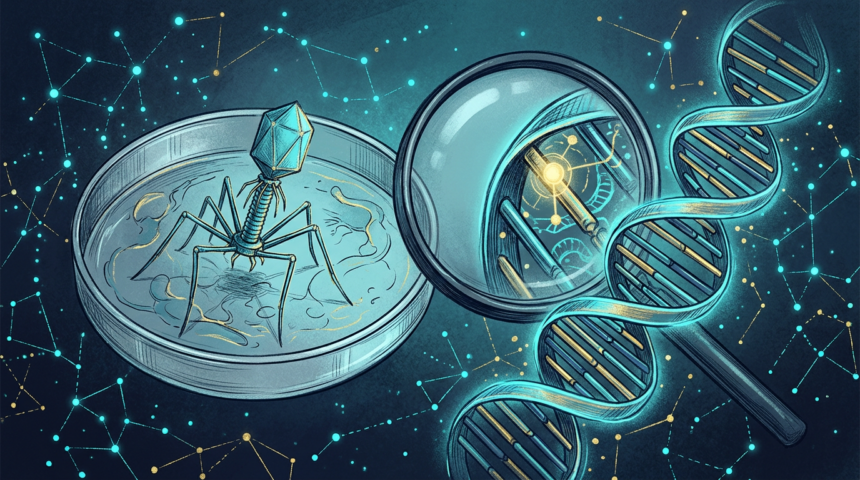
Anthropic says a swarm of Claude agents found a new enzyme system hiding in viral DNA, the first scientific result to come out of the company’s biology lab.
The search ran for 21 hours. Nearly 950 agents burned through 210M tokens over a database of genetic sequences before one flagged an odd repeating pattern for a human to check.
Bench work followed, and what emerged was an enzyme system nobody had characterised before. It sits inside bacteriophages, the viruses that prey on bacteria.
Anthropic describes the scientists’ role as narrow. They wrote the opening prompt and ran the bench experiments afterwards. The pattern recognition was the model’s.
The company compares the find to Crispr, the gene-editing machinery that also began as bacterial curiosity. That parallel is generous for now. Anthropic concedes it does not yet know what the enzyme system does, and that practical uses are unproven.
Announcing early was the point. Anthropic says it wanted to demonstrate Claude’s research value while recruiting scientists, and the lab’s remit stops short of drug discovery, which stays with partners. The push comes as frontier labs compete to show their models can produce science rather than merely assist with it.