


The Same Playbook, Different Price Tags
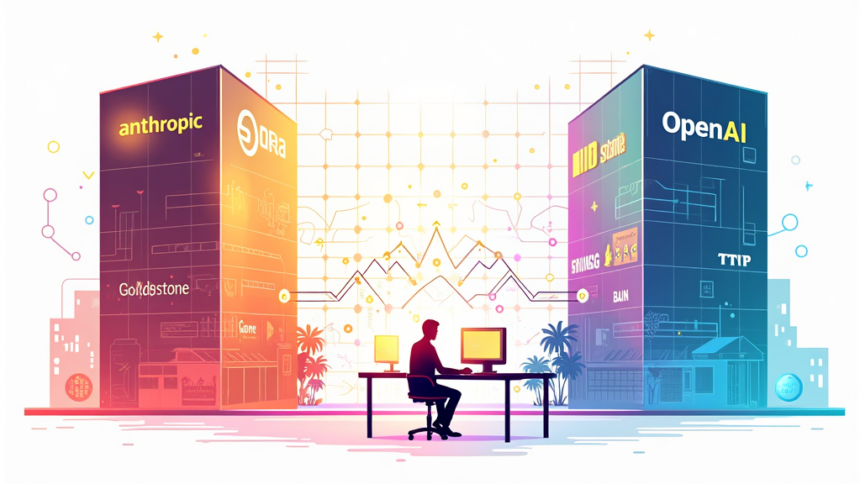
On Monday, Anthropic unveiled a joint venture with Blackstone, Hellman & Friedman, and Goldman Sachs, valued at $1.5 billion. The deal includes a $300 million commitment from each partner, with the promise of embedding engineers into portfolio companies to build custom AI tools. Hours earlier, Bloomberg revealed OpenAI’s parallel move: a $4 billion vehicle called The Development Company, valued at $10 billion, backed by TPG, Brookfield, and Bain Capital. The underlying strategy is identical: use private equity money to create a captive market for enterprise AI deployment. These aren’t technology partnerships; they are patronage networks designed to funnel consulting-style revenue back to the labs while insulating investors from market risk.
The Forward Deployed Mirage
Both ventures claim to embrace the ‘forward deployed engineer’ model made famous by Palantir. Anthropic’s announcement waxes poetic about clinicians and IT staff co-building tools that fit into existing workflows. This is deceptive framing. What’s really happening is that AI labs, facing astronomical burn rates and IPO pressure, are outsourcing their sales force to fund managers. The engineers sent to client sites will be generating bespoke solutions that can’t scale, locking customers into dependency on the lab’s next model release. It is a classic vendor lock in play, repackaged as collaborative innovation. The investors aren’t buying AI capability; they are buying preferential access to the next capital raise, turning enterprise AI into a financialized product.
A Dangerous Precedent for Deployment
If both ventures succeed, the industry will normalize the idea that enterprise AI deployment requires a fund of $10 billion and a private equity partner. This creates a barrier to entry that small and medium businesses cannot cross, handing market dominance to the incumbents. More concerning, the forward deployed model puts engineers directly into decision making pipelines for healthcare, finance, and logistics with minimal oversight. No independent red teaming or safety evaluation is mandated. The only check is the relationship with the investor. This is a recipe for drift where profit motive, not safety, shapes how models are deployed in high stakes contexts.
Source: Techcrunch