

Physicl emerged from stealth with $10M in seed funding led by Inovia Capital, betting that the bottleneck in robot learning is not data volume but data fidelity.
The company is the second act for founder and CEO Alex de Vigan, who spent a decade building nfinite, a service that helped brands render 3D product models for e-commerce. Transformer-based image generation ate that business. He kept the pipeline underneath it.
That pipeline turns unstructured, incomplete, heterogeneous real-world capture into 3D geometry with correct materials and physics. De Vigan concluded the missing capability in AI was spatial understanding, and that his old stack was aimed at the wrong market.
Why video and teleoperation are not enough
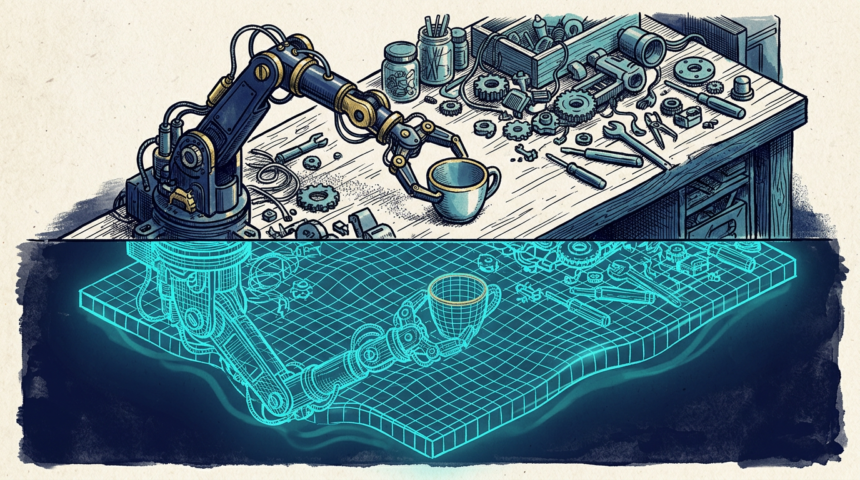
Teams training physical AI models have run into diminishing returns from video, and teleoperation is expensive to scale. Simulated worlds look like the answer until fidelity becomes the problem, because a robot that learns in a world with forgiving physics learns the wrong lesson.
Physicl’s first product is Studio, shipping with 10,000 3D environments and 100,000 assets. Customers build scenes to generate synthetic data against specific failure modes, such as a robot that cannot pick a cup out of a cluttered counter or one that loses it in shadow.
World model builder SpAItial used Physicl as an early customer for its Echo-3 release. Its founder Matthias Niessner, also a robotics professor at the Technical University of Munich, said manual curation is the real drag, and that generating needed data on the fly based on training state is what excites him.
A crowded, blurry category
His bet is narrower and more defensible: not more data, but data that behaves like the world.