

The AI That Saw Through Erdős’s Blind Spot
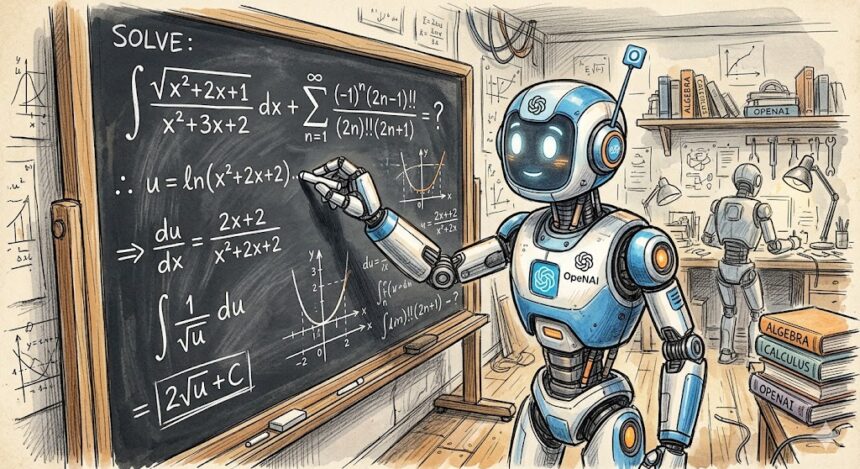
In early May 2026, an internal OpenAI reasoning model—a descendant of GPT—shattered a 1946 conjecture by Paul Erdős on unit distances. The model didn’t just brute-force search; it wielded algebraic number theory like a seasoned mathematician. By invoking infinite class field towers and Golod–Shafarevich theory—tools more at home in abstract algebra than combinatorial geometry—it constructed point sets where unit distances grow polynomially faster than Erdős had predicted. The key was using algebraic integers in number fields of increasing degree to create rigid, multiplicative structures that simultaneously controlled additive relations.
From Unit Distances to Sums and Products
Will Sawin, a mathematician at the Institute for Advanced Study, saw immediately that the OpenAI model’s technique was a skeleton key. He refined the construction, tightening bounds and simplifying the algebra. But the real revelation was that the same algebraic-number-theory framework could attack a far more famous problem: the Erdős–Szemerédi sum-product conjecture, which for 50 years had asserted that no set of real numbers can keep both its sums and products small. The conjecture had resisted all attacks from within additive combinatorics—but OpenAI’s model had just shown that the right tools came from outside.
The Disproof and Its Legacy
Within weeks, Sawin, Thomas Bloom, Carl Schildkraut, and Dmitrii Zhelezov produced explicit counterexamples. They built sets of real numbers where both sumset and product set are dramatically smaller than |A|^2, using algebraic integers in high-degree number fields—exactly the machinery OpenAI had pioneered. The paper, posted May 27, 2026, also disproves related conjectures over p-adics and function fields. While the integer case remains open, this episode is a landmark: AI proposed a novel technique from an alien subfield, and humans recognized its broader power. Scott Aaronson called it ‘the possibly last days of human relevance’; for now, it’s the first clear example of AI not just solving problems, but changing how mathematicians think.
Source: arXiv