


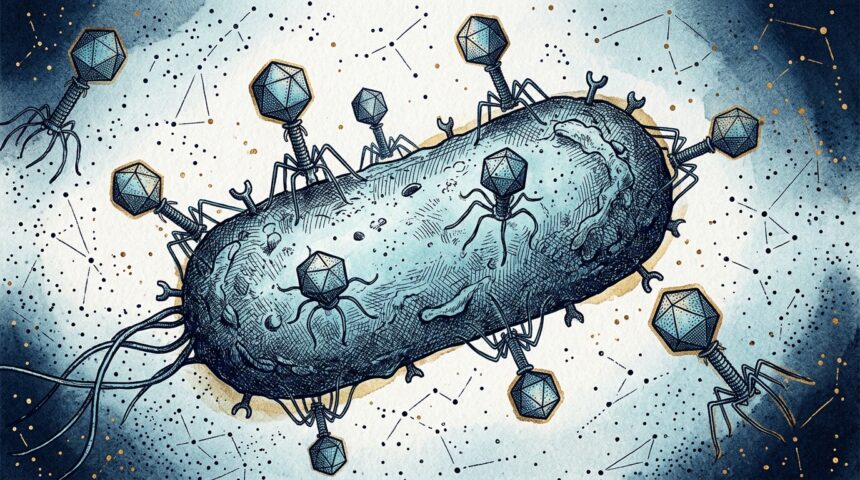
Stanford researchers used the Evo 2 generative AI model to design entirely new bacteriophages, then built and tested them in the lab. Of roughly 300 genomes synthesized from AI output, 16 produced fully functional viruses that infect and kill E. coli, and a cocktail of the 16 rapidly overcame bacteria that had evolved resistance to the natural virus.
The work centers on Phi X-174, a phage with a genome under 6,000 base pairs, small enough for the model to generate end-to-end in a single left-to-right pass. Evo 2, built by Stanford’s Brian Hie with the Arc Institute, was trained on millions of genomes from all domains of life. The model produced thousands of candidate genomes; a computational framework developed by graduate student Samuel King screened them before any DNA was synthesized.
Some AI-designed phages showed higher fitness than native Phi X-174 in laboratory testing. The researchers say the result, published this week in Science, demonstrates a path toward AI-generated phage therapies against rapidly evolving bacterial pathogens, and they plan to extend the approach to targets like MRSA and Pseudomonas aeruginosa.
Hie has released Evo 2 as open source, which has reignited biosecurity debates. Moritz Hanke of the Johns Hopkins Center for Health Security told The New York Times there is a huge disconnect between the speed of scientific advance and regulatory frameworks. Hie argues existing pathogens remain a greater risk than AI-designed ones, and that the same tools can speed pandemic response.
Researchers note the operational boundary: the model generated thousands of possibilities, but computational evaluation, chemical synthesis, and lab assays were still required to find the 16 that worked.