

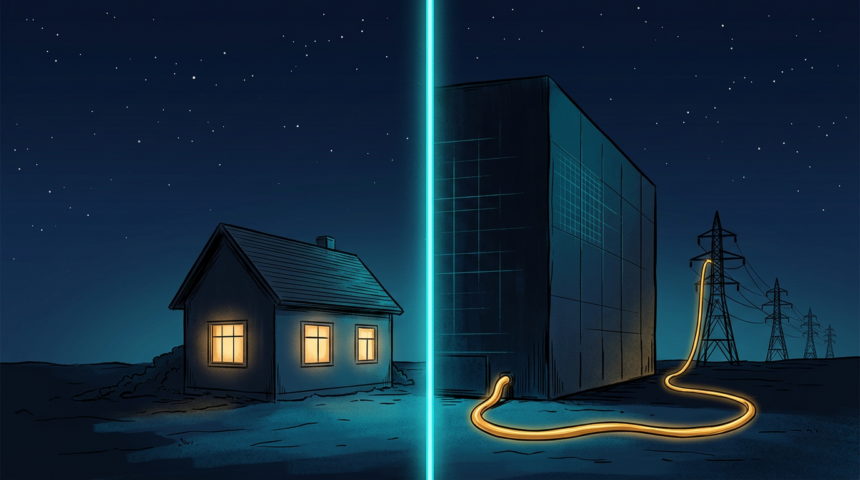
One hundred megawatts is the line the House drew between a customer and a large load.
That threshold sits inside the Ratepayer Protection Act, which passed 417 votes to 3 on September 16. The bill tells state utility regulators to weigh standards that make big data center customers carry the full cost of the grid work built for them.
Where the rule would live is Section 111(d) of the Public Utility Regulatory Policies Act of 1978, a statute from a very different era of electricity demand. Text reported on September 10 sets the requirement: a rate charged to a large-load customer must recover the full incremental cost of any generation, transmission or distribution upgrade needed to serve that customer. Costs that appear if the customer exits its contract are included. Before building, a utility would have to secure financial assurances.
The definition is narrow on purpose. It covers non-residential consumers buying power for facilities used primarily to run IT infrastructure, with peak demand of at least 100 megawatts at one site or campus. States would have one year to begin considering the standard and two to finish, unless an equivalent rule already exists.
Brett Guthrie, Bob Latta and Gabe Evans sponsored the bill and framed it as protection for households and small businesses. The chairman’s office says it writes into law the White House Ratepayer Protection Pledge signed earlier in 2026 by Amazon, Google, Meta, Microsoft, OpenAI, Oracle and xAI, along with more than 300 other organizations.
Support was not the same as satisfaction. Veronica Escobar voted for it while calling the bill the bare minimum, listing other data center measures she backs. The Senate now holds the text, and Latta is pressing for speed.