


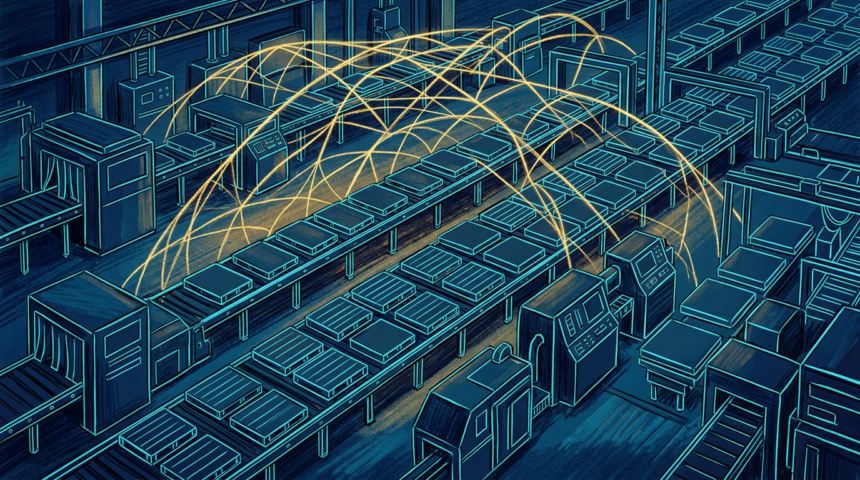
Weekly decisions about which factory receives which parts are now made with help from Palantir Foundry and cuOpt, the GPU-accelerated optimization library NVIDIA publishes as open source.
NVIDIA tracks delivery across two windows it calls time-to-rack and time-to-token, which together cover the stretch from wafer output to a working token. Hardware complexity has made that stretch harder to manage.
A single Grace Blackwell NVL72 rack holds 18 compute trays. Every tray calls for two Grace CPUs, four Blackwell GPUs and 32 HBM3e memory packages. Those parts come from thousands of suppliers, contract manufacturers and design partners, and the network behind the coming Vera Rubin generation will be twice as large.
Materials reach the line through three channels: direct inventory, consignment stock and outside suppliers. When one slips, assembly waits, and the delay shows up in a metric NVIDIA calls time of ownership. Planners rework the allocation weekly, looking two quarters out.
To coordinate all of it, the operations team built a Digital Supply Chain Intelligence command center on Foundry, whose ontology models facilities, supplier commitments, component stocks and production targets as linked objects. cuOpt reads that layer and formulates distribution as a mixed-integer linear program that minimizes time of ownership across every tier of the bill of materials.
Math alone could not capture what human planners watch — supplier calls, weather, partner emails, geopolitics — so NVIDIA post-trained Nemotron 3.5 Lightning, a 30B mixture-of-experts model with about 3B active parameters, after redacting sensitive fields from historical records. It reached 86.7 percent decision accuracy against 55.5 percent for the larger Nemotron 3 Ultra and 17.5 percent for the untuned base model. Fine-tuning ran on two B200 GPUs and finished in minutes, and planner overrides flow back into the ontology to build preference pairs for reinforcement learning.