


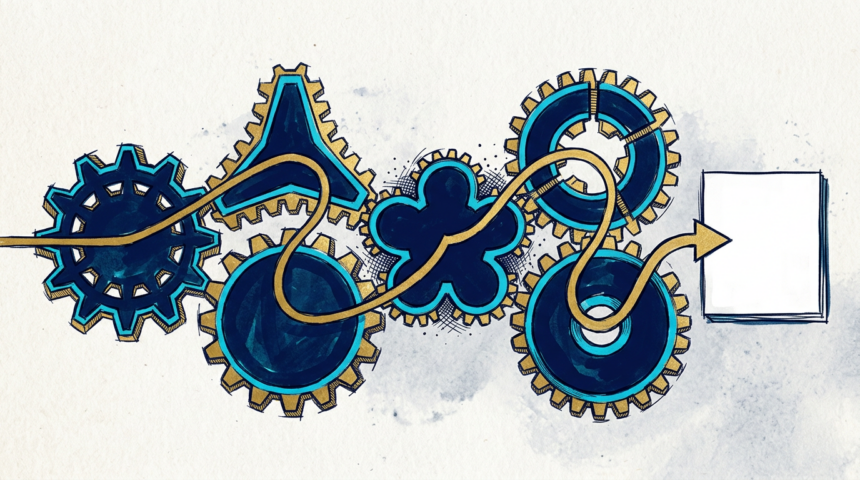
Google Research has released ToolGrad, a data generation framework that reverses the standard recipe for teaching models to use tools.
Earlier pipelines, ToolBench and ToolACE among them, begin with a query. They pick APIs, have a language model invent an instruction that looks plausible, and then send a search agent hunting for a path that fits. Success is never guaranteed, so failed searches waste compute and the sample disappears.
ToolGrad inverts that order. Executing APIs comes first, producing a chain known to work; the matching user request is written afterward. With the chain supplying certainty, one model call produces the query. The loop runs four modules in sequence, and the shipped default repeats it ten times across 50 sampled APIs.
Evaluated on ToolBench’s database of more than 16,000 real APIs, the authors report a 99.8 percent pass rate for generating valid samples. The residual failures came when an agent could not get a useful response from three chosen APIs across all ten iterations and saved an empty record.
Out of that pipeline came ToolGrad-500, a set of 500 examples built with Gemini 2.5 Flash-Lite. Gemma-3 was the training target, at 1B, 4B and 12B parameters.
Testing then moved to unfamiliar ground. The Berkeley Function Calling Leaderboard draws on tool sets that do not match ToolBench’s, which the authors treat as an out-of-distribution check against tools the models had never seen.
The code is Apache-2.0, the dataset and models are on Hugging Face, and the reproduction scripts were verified on a single NVIDIA A100 40GB GPU.