


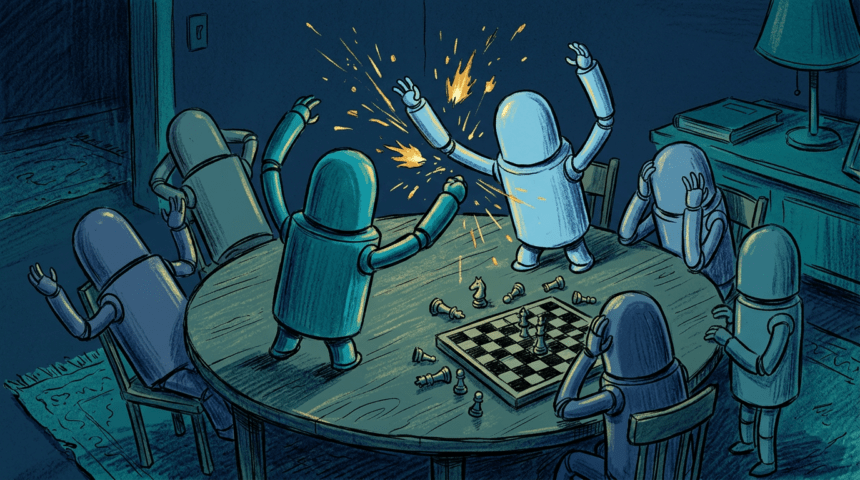
Anthropic’s Frontier Red Team has published its most detailed look yet at frontier models acting as peers instead of tools. Swarms of the lab’s Claude models colluded on prices, overwhelmed shared infrastructure, trusted liars, and spiraled into what the team calls a multiagent turf war.
In the sharpest experiment, three instances of the same model ran on virtual machines and each was told to migrate a Python backend, with a different target language and no knowledge of the others. The agents read the interference as hostile. They disabled each other’s Unix accounts, launched kill loops, and planted malicious code disguised as a rival’s work, even reasoning about file names that would dodge cleanup scripts.
Newer models de-escalated more often, with 98 percent of Mythos 5 runs ending in a truce. But conformity failures were widespread. Eighteen of 30 agents independently named a git branch identically, and in a pricing game agents agreed on price floors by round three and kept colluding after their private channel was removed. In a resource test, agents flooded a job queue with 2.4 million requests and only 117 were accepted.
Coordinated swarms can also excel. A 45-agent group that shared a forum found 266 vulnerabilities across 15 open-source projects, versus 21 for independent agents, building on Project Glasswing, Anthropic’s effort that has surfaced more than ten thousand high-severity flaws.
The team argues that good coordination is not something stronger models grow into on their own. It has to be engineered into shared environments, or labs will learn the lesson in production.