

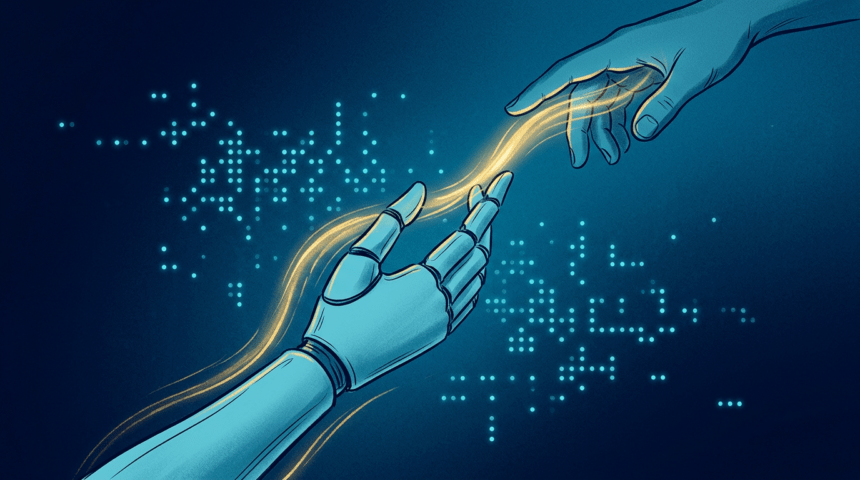
Dyna Robotics says its new robot foundation model, Dyna-2, learned from more than one million hours of egocentric human video, equal to roughly 170 years of waking experience, and can transfer that physical intuition to hardware it never saw in training.
The claim behind it is a human-to-robot scaling law: performance improves predictably with each added hour of human footage, without plateaus, which the company calls a new scaling axis for physical AI that bypasses the scarce, hand-collected teleoperation data that has long choked generalist robotics.
In high-precision manufacturing trials, the model lifted task success rates from 20% to 80-90% purely through pre-training scale, with no changes to post-training data, and delivered zero-shot performance at production-level speed across new deployment sites.
The system runs a dual next-frame and next-action world-modeling architecture, with video and action streams trained through flow matching. The action branch stays shallow and joins early, keeping the policy reactive at inference time.
There are no open weights. Dyna sells robot cells, and robots running the earlier Dyna-1 model already work in hotels, restaurants, and laundromats.