


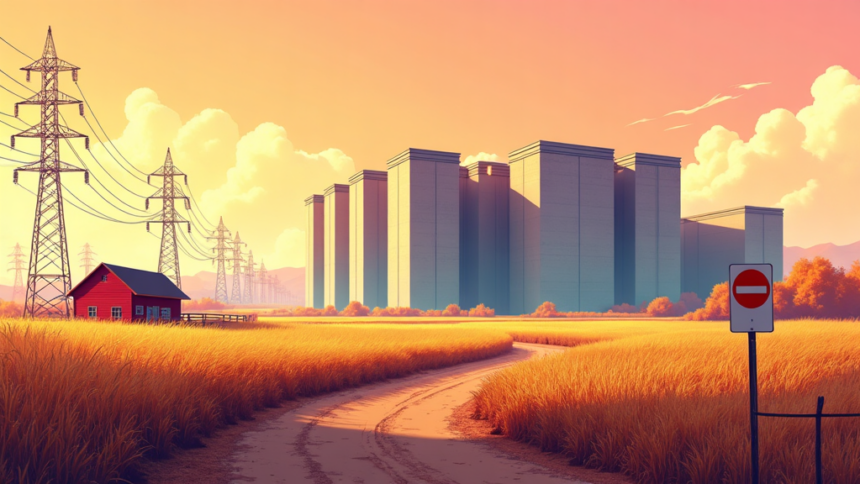
The Aquifer War: When AI Thirst Meets Farm Drought
In Tazewell County, Illinois, farmer Michael Deppert found himself in an unexpected battle. A data center developer wanted to build eight miles from his farm, planning to tap the same aquifer he uses to irrigate his pumpkins and corn. The fight was swift and fierce. Residents packed city council meetings, launched petitions, and ultimately killed the project. This is not an isolated skirmish. It is the front line of a war between Big Tech’s insatiable hunger for AI infrastructure and rural communities who refuse to sacrifice their water and way of life. The data center industry, desperate for cheap land and tax breaks, has fixated on farm country. According to Pew Research Center, 67 percent of planned data centers are in rural areas, flipping the historical urban majority completely. But locals are waking up. They see through the promises of jobs and tax revenue. They see the water consumption projections from Lawrence Berkeley Lab that forecast hyperscaler data centers will guzzle between 16 billion and 33 billion gallons of water annually by 2028. They see that Meta’s facility in DeKalb, Illinois can legally consume 1.2 million gallons per day, roughly comparable to the entire peak water demand of the 40,000 person city itself. The math is brutal, and the resentment is building.
The Faustian Bargain: Cash vs. Collapse
The picture is not uniformly bleak. Some farmers, like Jamie Walters in DeKalb, have made peace with the invasion. He has leased hundreds of acres for solar panels to power the data centers now rising on the prairie his family has worked for five generations. Where corn might net $100 an acre in a good year, solar can generate thousands. ‘I’d rather be inside the process than standing on the outside saying no,’ he says. This is the Faustian bargain at the heart of the AI land rush. Data centers now account for 80 percent of US private sector growth in the first half of 2025, per S&P Global. Land values in power-connected corridors can spike five to ten times above normal. But the deal comes with hidden costs. Developers push ‘closed loop’ cooling systems as a green solution, but UC Riverside researcher Shaolei Ren reveals these alternatives consume 25 to 35 percent more electricity in summer, simply shifting the burden from local water systems to strained regional grids. Meanwhile, in Tucker County, West Virginia, a proposed gas-powered data center complex near the town of Davis faces furious opposition. The local treatment plant can produce only 250,000 gallons per day, and it ran dry during a recent drought. A single large data center would require millions. When the well runs dry, as Sierra Club conservation chair Jim Kotcon warns, no amount of tax revenue will bring the water back. The industry wants farmers to bet the farm on AI. Smart money says that is a sucker’s bet.
Source: Arstechnica