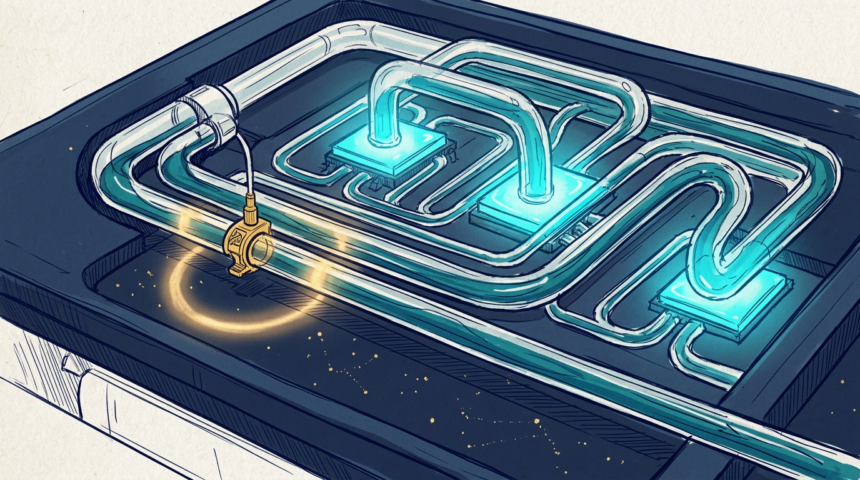
Omen AI has acquired rival sensor maker Aquatic Labs in a $16M cash-and-stock deal. Both companies build instruments that read cooling fluid in real time, sparing operators the multi-day process of shipping samples to a laboratory.
The pairing is technical rather than geographic. Omen’s sensors track elements dissolved in the water, while Aquatic Labs measures alkalinity. Combined into one probe, the two readings describe the state of a cooling loop far more completely than either alone.
Why fluid measurements decide uptime
US data centres use 17 to 19 billion gallons of water a year cooling chips, a figure the Water Foundation expects to triple within five years. Treating and moving that water is expensive, and discharging it is increasingly a permitting matter.
When a loop drifts, operators usually dump the fluid rather than risk fouling expensive hardware, then halt operations while the system is refilled and restored. Monitoring lets the same charge stay in service longer and narrows the cost of a cleanup.
Two founders, one sensor
Omen’s founder Zach Laberge left high school to run a business analysing hydraulic fluid. Aquatic Labs chief executive Allan Adams came from physics and a career building ocean instruments at MIT and the Woods Hole Oceanographic Institution. Adams becomes chief science officer.
Omen raised a $31M Series A in June. Its sensors are due to monitor chips drawing 250 to 300 MW by year end, with the company eyeing the equivalent of 1GW by the end of 2027.
The merged sensor is expected to reach market early next year, by which point the question of who pays for water accountability in AI may be better defined.