Thursday, 29 Oct 2026
Subscribe to AIWatcher
AIWatcher
  • Home
  • News

    OpenAI’s Berlin pitch was about owning the runtime, not the model

    By
    AIWadmin

    A one-researcher model lab ships a 10M-token coding engine

    By
    AIWadmin

    Liquid AI branches six small models off one backbone

    By
    AIWadmin

    Google gives language models a sleep cycle to remember new facts

    By
    AIWadmin

    Harvey clears the federal security bar for legal AI

    By
    AIWadmin

    Musk predicts a cull of 200 neoclouds as debt markets close

    By
    AIWadmin
  • Articles

    Google hands Oracle the keys to sell its TPUs

    By
    AIWadmin

    Airbnb drags recommendation data from two days old to twenty seconds

    By
    AIWadmin

    Android Studio opens its doors to Claude, Codex and 40 other agents

    By
    AIWadmin

    A Delaware plan would let software run companies with nobody in charge

    By
    AIWadmin

    OpenAI halves its agent pricing with a cheaper vision model

    By
    AIWadmin

    Claude for Legal now checks its own citations first

    By
    AIWadmin
  • Spotlight

    Circuit Mind puts a swarm of agents on schematic review

    By
    AIWadmin

    Upwind turns down a takeover and raises more instead

    By
    AIWadmin

    DeepMind keeps Gemini 4 Carbon behind a cyber defenders gate

    By
    AIWadmin

    Nvidia folds three speech jobs into a single open model

    By
    AIWadmin

    An inference cloud bets on rival silicon while the bears circle

    By
    AIWadmin

    Publishing staff threw a party for an AI assistant that died

    By
    AIWadmin
  • About
    • Mission
    • Services
    • Contact
  • Newsletter
  • Shop
    • All Items
    • By Category
      • Hats
      • T-Shirts
    • Cart
  • 🔥
  • Alignment
  • Classification
  • Distillation
  • Explainability
  • Hallucination
  • Legal/Compliance
  • Medical
  • NLM
  • Mobility
  • Research
  • Robotics
  • Safety
  • Startups
  • Prompt
  • Python
  • RAG
  • RLHF
  • Token
  • Vision
Font ResizerAa
AIWatcherAIWatcher
  • Home
  • News
  • Articles
  • Spotlight
  • About
  • Newsletter
  • Shop
Search
  • Home
  • News
  • Articles
  • Spotlight
  • About
    • Mission
    • Services
    • Contact
  • Newsletter
  • Shop
    • All Items
    • By Category
    • Cart
Have an existing account? Sign In
Follow US
© 2022 Foxiz News Network. Ruby Design Company. All Rights Reserved.
Articles

Microsoft lets a thousand agents organize themselves on one job

The Agensh harness drops the central orchestrator and lets workers claim their own share of a coding task.

AIWadmin
Last updated: October 26, 2026 1:22 am
AIWadmin
ByAIWadmin
Global AI news & information.
Follow:
Share
SHARE

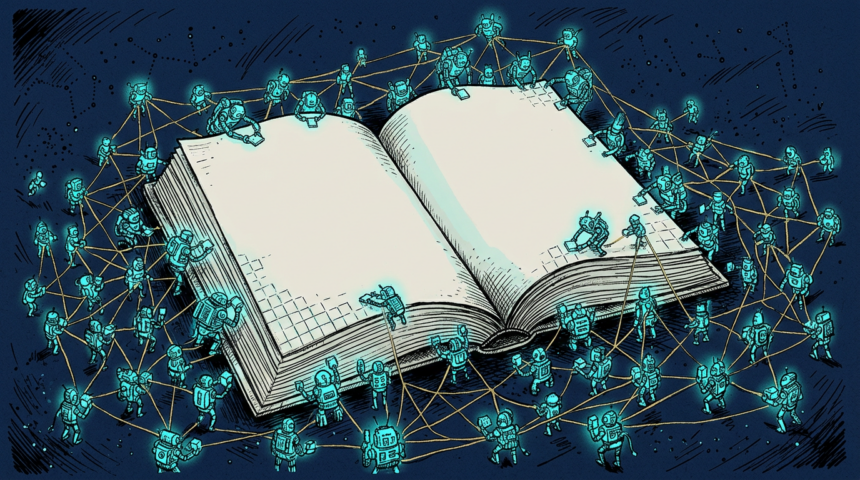
Microsoft has released Agensh, a multi-agent harness that removes the conductor. Instead of one planner handing out work, every agent reads a shared workspace, claims a piece of the problem and posts findings back for the others.

The research team, drawn largely from Microsoft’s Beijing lab, tested it by having teams rebuild well-known programs from behavioral tests and bundled documentation. Runs got six hours on a fixed budget with no internet access.

Scaling was the experiment. On the program pandoc, a single worker passed 33.89 percent of the final tests. At 128 workers the figure reached 50.94 percent, and a 1,024-worker run finished at 55.06 percent. Across the five hardest tasks in the suite, the average climbed from 19.31 percent to 28.78 percent when the team went from one to 128.

Bigger teams also got there sooner. On pandoc, 128 agents crossed 30 percent within half an hour, while teams of 32 and 8 needed an hour and ninety minutes to hit the same mark.

The interesting finding is social. As the roster grew, the agents began specializing without being told to. Peer coordination turned into integration workflows, and some workers settled into reviewing others’ output.

Swapping in a stronger base model lifted results further. With the newest GPT-6.1 model at high reasoning effort, the six-hour pandoc score went from 56.19 percent for one agent to 79.59 percent for 32.

The code is on GitHub with a Docker Compose setup for a single-node team plus a standalone baseline. The paper appears on arXiv, published ahead of this week’s release.


TAGGED:AgenshAI Researchcoding agentsMicrosoftmulti-agent systemsopen source AI
SOURCES:MarkTechPostAgensh project pageGitHub
Share This Article
Email Copy Link Print
ByAIWadmin
Follow:
Global AI news & information.
Previous Article Apollo economist finds no profit lift outside the big tech names
Next Article Meta commits large model training to Google chips through a new backend

You Might Also Like

News

Microsoft bakes AI governance into the runtime layer

By
AIWadmin
Articles

AWS swallows DuckDB creator DuckLabs in database bet

By
AIWadmin
News

Microsoft taps AMD EPYC and Helios AI for three new Azure VM families

By
AIWadmin
Articles

Developer survey paints AI coding as a habit that is hard to quit

By
AIWadmin
AIWatcher
Facebook Twitter Youtube Linkedin Rss

Global AI News and Information
AIWatcher is your definitive source for AI updates worldwide, from Silicon Valley to Shanghai.
Our industry coverage keeps you in the loop with the latest news and trends shaping the future of AI.

Quick Links
  • News
  • Articles
  • Spotlight
  • Events
About Us
  • Mission
  • Services
  • Contact
  • Privacy Policy
  • Legal
© 2026 AIWatcher. All Rights Reserved.