Eka Robotics closed a $150M Series A at a $1.45B post-money valuation, led by a16z and F-Prime.
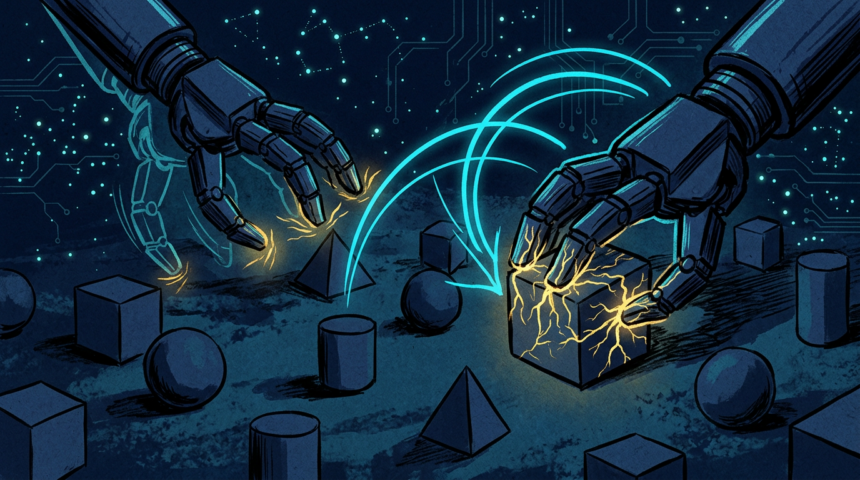
The company was founded by MIT professor Pulkit Agrawal and Tuomas Haarnoja, a former Google DeepMind researcher. Its product pairs a force-sensitive gripper with a manipulation model trained for dexterity rather than recognition.
Picking things up remains one of robotics’ stubborn problems. Billions in investment and endless video datasets have produced machines that still fumble unfamiliar objects.
What surprised the roboticists
Raghu Raguram, the a16z partner who co-led the round, said the system already exceeds human performance on some tasks and expects that to extend across many dexterous manipulation jobs within months.
Kris Hauser of the University of Illinois Urbana-Champaign described a wow factor compared with other demonstrations he had seen, and singled out two behaviours. The robot adapted to a large variety of objects without retraining, and it kept retrying after failure in a way he called creepily human.
Persistence is the interesting part. Retrying a failed grasp requires the system to notice failure and vary its approach, which is closer to learning in the loop than to executing a trained trajectory.
The round makes Eka one of the most valuable young robotics companies, and it sets an expectation. Investors are now pricing manipulation capability rather than robot demonstrations, and the next milestone will be repetition at customer scale.