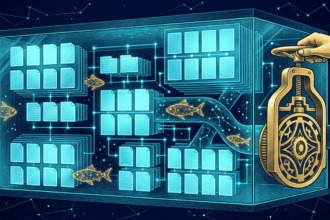
Researchers at Sakana AI and UC Berkeley have put forward Multi-Agent Self-Supervision, a technique that allows a single language model to get better at its job with no stronger teacher guiding it. The same model tackles tasks, scores the outcomes and reorganizes how the work is structured.
Marvin Minsky’s Society of Mind supplied the inspiration. Work is described as text tacked onto the prompt, spelling out what each sub-agent is meant to do. Which information every sub-agent must hand back, and what checks it runs, is fixed by a contract; the order of calls comes from a hop; and assignments are parceled out by an orchestrator.
There are two training loops. Weights stay frozen during the inner loop, where candidate workflows are pitted against a reigning champion. In the outer loop the champion tackles each task 18 times, ranks its own outputs, and keeps as many as 15 of those runs to train on.
Qwen3.6-27B serves as the base model. Win rate versus that base rose from 53.9 percent following a single round to 69.9 percent after two. Per output token, the model scored between 1.2 and 1.6 times the base across four benchmarks.
Scrutinized closely, the improvements look thinner. From 0.473, raw DSBench scores crept only to 0.482, and Terminal-Bench 2.0 plus SWE-bench Verified both dipped a little. Average grade among finished MLR-Bench submissions fell from 3.07 to 2.88 even as the count of completed entries climbed from 31 to 50 out of 60.
Across all 180 runs the delegation tool sat unused, leaving the researchers unable to attribute the gains to teamwork. Compared task by task, the improvements lose statistical significance. The blind spot agents share is the heart of the trouble: a model that overlooks its own faults can pass those faults along as training material.