


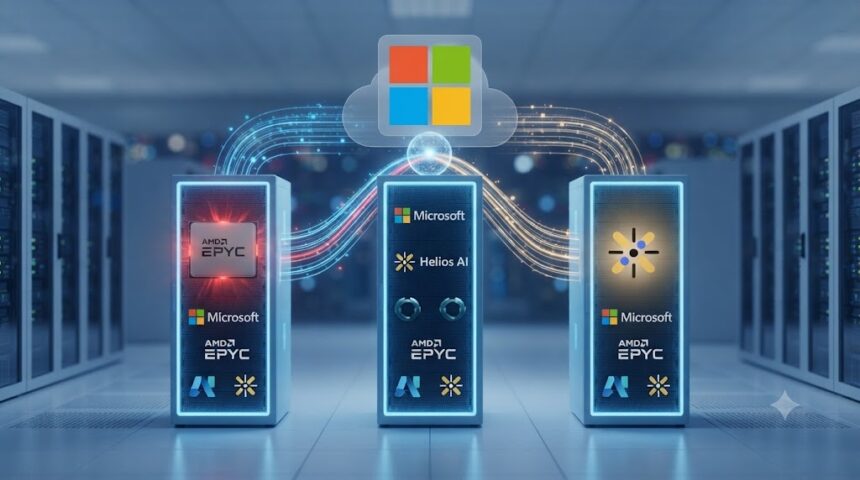
Microsoft announced a major expansion of its Azure AI infrastructure on July 20, integrating AMD’s latest Helios AI platform and next-generation EPYC processors across three new virtual machine families designed for inference, data processing, and chip design workloads.
The new HDv2 virtual machines target AI data systems with nearly 500 AMD EPYC CPU cores, four terabytes of RAM, 32 terabytes of local NVMe storage, and 400 gigabit Azure Boost networking. These are built for data preparation, search, reinforcement learning, and agent coordination at scale, addressing bottlenecks that slow AI training pipelines.
For silicon design and technical computing, Azure HXv2 virtual machines feature 176 sixth-gen AMD EPYC cores clocked above 5 gigahertz, 50 percent more addressable cache per core, and 800 gigabit InfiniBand for large-scale simulations. AMD itself uses the HX series for designing its own EPYC CPUs and Instinct GPUs.
The third offering, ND MI455X v7, is powered by AMD’s Helios rackscale solution and purpose-built for production-scale AI inference, including reasoning, search, and agentic workloads. Microsoft framed the expansion as part of a strategy to provide customers with heterogeneous infrastructure choices rather than a single-vendor approach, with AMD joining Microsoft’s own purpose-built silicon in the Azure fleet.
The new VMs will be available in the coming months through Azure’s global infrastructure.