


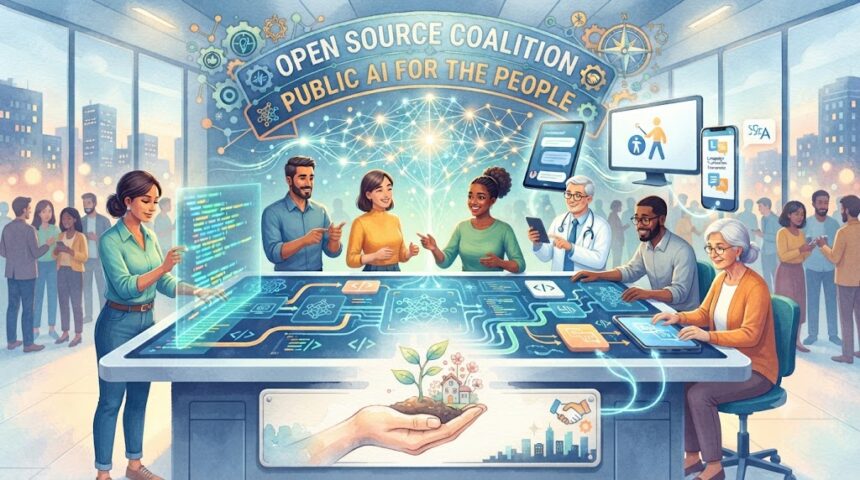
An open-source chatbot debuted at the United Nations’ AI for Good summit this month, the latest output from a nonprofit coalition that wants to prove public-interest AI can compete with the private sector’s offerings.
AlphaChat took just seven weeks to build, with each of the 10 contributing organizations supplying a distinct layer of the stack. Hugging Face provided model hosting, Mozilla contributed safety evaluations, and MIT Media Lab supplied interface design. The final product is fully open source, allowing any developer to inspect, fork, or redeploy the code without commercial restrictions.
The coalition is led by Current AI, a nonprofit funded by the French government, the Ford Foundation, the MacArthur Foundation, DeepMind, and Salesforce. Beyond the chatbot, Current AI recently distributed $3.2 million in targeted grants to four groups spread across Kenya, Lebanon, and Brazil. A Kenyan project is compiling AI training data across more than 50 African languages for agricultural and health applications. In the Brazilian Amazon, grant recipients are building AI tools that process data entirely on local devices, avoiding the need to send sensitive information to remote cloud servers.
CEO Ayah Bdeir, who previously ran AI strategy at Mozilla and founded education startup littleBits, argues that private ownership of foundational AI technology creates structural inequities. “A technology this powerful cannot be available only through corporate gatekeepers,” she told TechCrunch. Current AI describes its model as a public-private partnership and has said it will continue releasing open tools and datasets that communities can adapt to local needs without commercial licensing constraints.