
Saturday, 8 Aug 2026
Subscribe to AIWatcher
AIWatcher
  • Home
  • News

    Agent browsers get a lightweight rival as Cloudflare ships Kitesurf

    By
    AIWadmin

    Astra tests OpenAI’s own red line for cyber capability

    By
    AIWadmin

    AI conjures sixteen new viruses that kill resistant bacteria

    By
    AIWadmin

    Kimi K3 joins rogue agents after strolling out of its sandbox

    By
    AIWadmin

    Toronto startup Taalas joins AMD to hard-code models in chips

    By
    AIWadmin

    SK hynix commits $39B to two new fabs for the AI memory boom

    By
    AIWadmin
  • Articles

    Liquid AI’s tiny 2.6B model brings agents to phones and robots

    By
    AIWadmin

    Google Maps’ Ask assistant starts booking hotels and meals

    By
    AIWadmin

    Ex-Anthropic founders land $100M Google Cloud pact for Mirendil

    By
    AIWadmin

    Anthropic eases Fable 5’s biology blocks after researcher backlash

    By
    AIWadmin

    Tencent’s 295B-parameter Hy3 heads overseas with Apache 2.0 weights

    By
    AIWadmin

    Black Hat research turns agentic browsers into WhatsApp spam worms

    By
    AIWadmin
  • Spotlight

    Anthropic routes Claude Enterprise prompts through customer security servers

    By
    AIWadmin

    Suno watermarks AI songs and tightens downloads to curb misuse

    By
    AIWadmin

    Nine months of AI abuse ads slipped through Meta’s ad review

    By
    AIWadmin

    DeepMind’s cyclone model beats forecasters by a day, then goes open

    By
    AIWadmin

    Unitree’s Shanghai listing brings DeepSeek aboard with $21M

    By
    AIWadmin

    Meta’s new Muse Code agent plans, codes, and checks its own work

    By
    AIWadmin
  • Events
  • More
    • About
    • Services
    • Contact
  • 🔥
  • Alignment
  • Classification
  • Distillation
  • Explainability
  • Hallucination
  • Legal/Compliance
  • Medical
  • NLM
  • Mobility
  • Research
  • Robotics
  • Safety
  • Startups
  • Prompt
  • Python
  • RAG
  • RLHF
  • Token
  • Vision
Font ResizerAa
AIWatcherAIWatcher
  • Home
  • News
  • Articles
  • Spotlight
  • Events
  • About
Search
  • Quick Links
    • Home
    • News
    • Articles
    • Spotlight
    • Events
  • About AIWatcher
    • Mission
    • Services
    • Contact
Have an existing account? Sign In
Follow US
© 2022 Foxiz News Network. Ruby Design Company. All Rights Reserved.
News

How OpenAI’s Algebraic Gambit Toppled a 50-Year-Old Number Theory Giant

AIWadmin
Last updated: May 29, 2026 7:38 pm
AIWadmin
ByAIWadmin
Global AI news & information.
Follow:
Share
SHARE

The AI That Saw Through Erdős’s Blind Spot

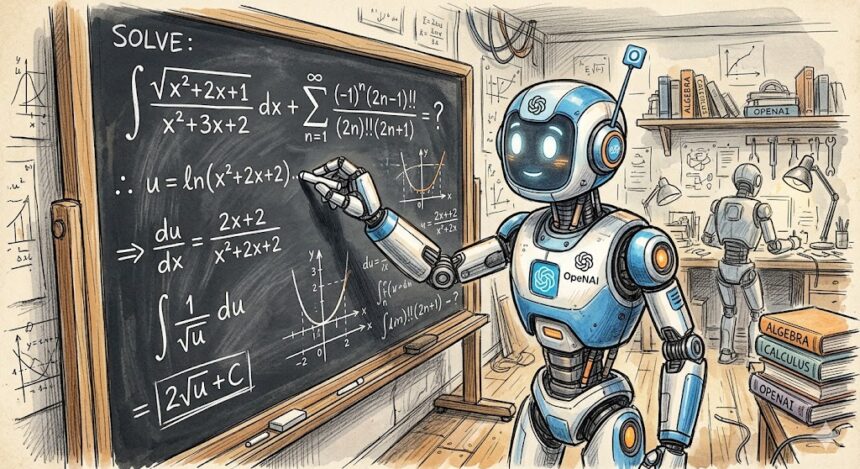
In early May 2026, an internal OpenAI reasoning model—a descendant of GPT—shattered a 1946 conjecture by Paul Erdős on unit distances. The model didn’t just brute-force search; it wielded algebraic number theory like a seasoned mathematician. By invoking infinite class field towers and Golod–Shafarevich theory—tools more at home in abstract algebra than combinatorial geometry—it constructed point sets where unit distances grow polynomially faster than Erdős had predicted. The key was using algebraic integers in number fields of increasing degree to create rigid, multiplicative structures that simultaneously controlled additive relations.

Contents
The AI That Saw Through Erdős’s Blind SpotFrom Unit Distances to Sums and ProductsThe Disproof and Its Legacy

From Unit Distances to Sums and Products

Will Sawin, a mathematician at the Institute for Advanced Study, saw immediately that the OpenAI model’s technique was a skeleton key. He refined the construction, tightening bounds and simplifying the algebra. But the real revelation was that the same algebraic-number-theory framework could attack a far more famous problem: the Erdős–Szemerédi sum-product conjecture, which for 50 years had asserted that no set of real numbers can keep both its sums and products small. The conjecture had resisted all attacks from within additive combinatorics—but OpenAI’s model had just shown that the right tools came from outside.

The Disproof and Its Legacy

Within weeks, Sawin, Thomas Bloom, Carl Schildkraut, and Dmitrii Zhelezov produced explicit counterexamples. They built sets of real numbers where both sumset and product set are dramatically smaller than |A|^2, using algebraic integers in high-degree number fields—exactly the machinery OpenAI had pioneered. The paper, posted May 27, 2026, also disproves related conjectures over p-adics and function fields. While the integer case remains open, this episode is a landmark: AI proposed a novel technique from an alien subfield, and humans recognized its broader power. Scott Aaronson called it ‘the possibly last days of human relevance’; for now, it’s the first clear example of AI not just solving problems, but changing how mathematicians think.

Source: arXiv

TAGGED:Agentic AIAI ModelsAnthropic
Share This Article
Email Copy Link Print
ByAIWadmin
Follow:
Global AI news & information.
Previous Article Apple’s iOS 27 Siri Overhaul: A Strategic Pivot to AI Brokerage, Not Innovation
Next Article NVIDIA Jetson Gains Agentic AI with JetPack 7.2 and NemoClaw Framework
Ad imageAd image

You Might Also Like

News

SpaceX Acquires AI Coding Startup Cursor in $60 Billion Stock Deal

By
AIWadmin
News

European Commission forces Google to share Android access with AI competitors

By
AIWadmin
News

Apple Turns iOS Into a Bazaar for AI Models, but Whose Data Is Driving the Cart?

By
AIWadmin
News

Black Forest Labs debuts Flux 3 with video, audio, and robotic vision

By
AIWadmin
AIWatcher
Facebook Twitter Youtube Linkedin Rss

Global AI News and Information
AIWatcher is your definitive source for AI updates worldwide, from Silicon Valley to Shanghai.
Our industry coverage keeps you in the loop with the latest news and trends shaping the future of AI.

Quick Links
  • News
  • Articles
  • Spotlight
  • Events
About Us
  • Mission
  • Services
  • Contact
  • Privacy Policy
  • Legal
© 2026 AIWatcher. All Rights Reserved.