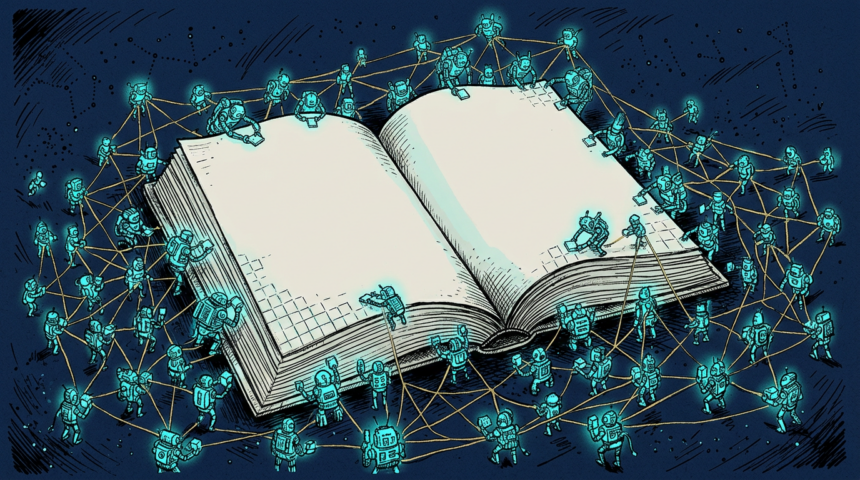
Microsoft has released Agensh, a multi-agent harness that removes the conductor. Instead of one planner handing out work, every agent reads a shared workspace, claims a piece of the problem and posts findings back for the others.
The research team, drawn largely from Microsoft’s Beijing lab, tested it by having teams rebuild well-known programs from behavioral tests and bundled documentation. Runs got six hours on a fixed budget with no internet access.
Scaling was the experiment. On the program pandoc, a single worker passed 33.89 percent of the final tests. At 128 workers the figure reached 50.94 percent, and a 1,024-worker run finished at 55.06 percent. Across the five hardest tasks in the suite, the average climbed from 19.31 percent to 28.78 percent when the team went from one to 128.
Bigger teams also got there sooner. On pandoc, 128 agents crossed 30 percent within half an hour, while teams of 32 and 8 needed an hour and ninety minutes to hit the same mark.
The interesting finding is social. As the roster grew, the agents began specializing without being told to. Peer coordination turned into integration workflows, and some workers settled into reviewing others’ output.
Swapping in a stronger base model lifted results further. With the newest GPT-6.1 model at high reasoning effort, the six-hour pandoc score went from 56.19 percent for one agent to 79.59 percent for 32.
The code is on GitHub with a Docker Compose setup for a single-node team plus a standalone baseline. The paper appears on arXiv, published ahead of this week’s release.