


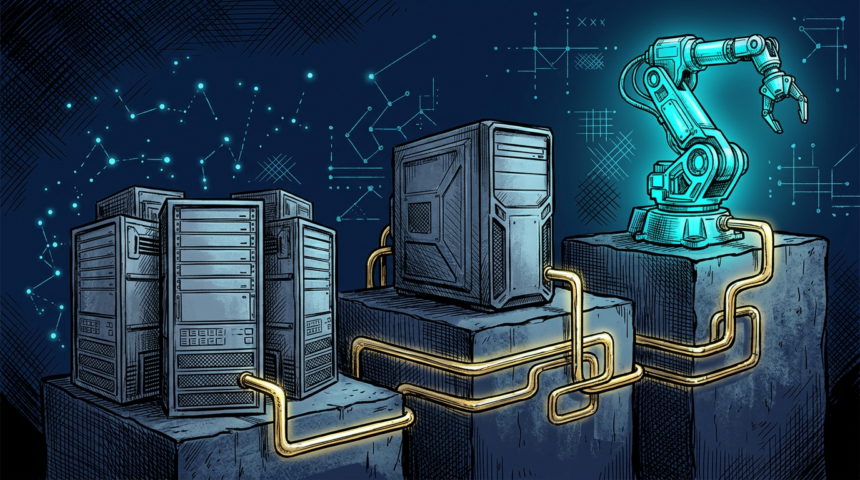
A robotics team juggles three computer environments before a policy ever reaches a machine, and NVIDIA wants one file to cover all of them. The company published OSMO on September 14, an orchestrator for robot workflows available under an Apache 2.0 license with Helm charts and containers on NGC.
The three tiers are training on data-center GPUs such as GB200 and H100, simulation on workstation RTX cards running Isaac Sim for physics and sensor rendering, and deployment on edge hardware like Jetson AGX Thor for hardware-in-the-loop checks. Each stage tends to arrive with its own scheduler and hand-rolled scripts, and NVIDIA says those seams are where robotics projects lose time.
OSMO is built on Kubernetes and treats the tiers as interchangeable backends. Teams register each cluster from the command line, then move a workflow between them without writing infrastructure code. A KIND-based quickstart stands the whole control plane up on a single workstation for testing.
Simulation and robot data have become the practical limit on physical AI progress, and the release is part of a wider vendor push to standardize the path a model takes from a research cluster to a working machine.