


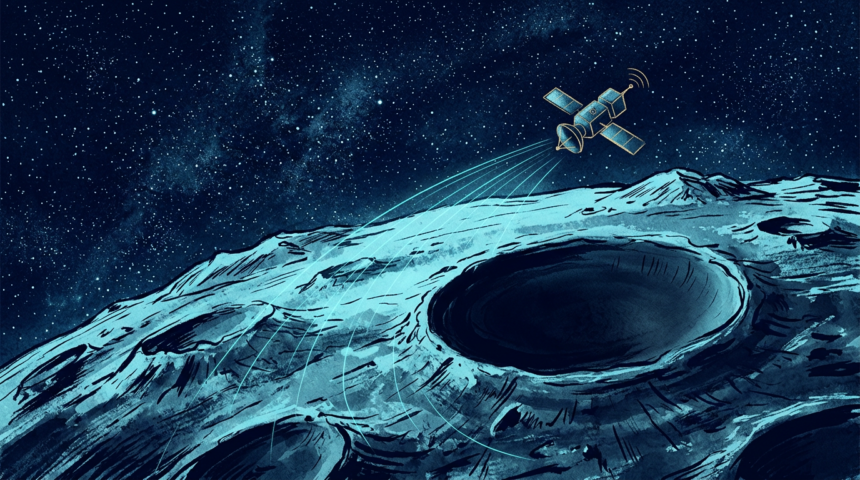
Finding water ice on the Moon means looking where sunlight never reaches, and NASA now has a model trained for the job. IBM and NASA published the NASA-IBM Lunar Foundation Model on September 10, one of the first openly available foundation models built for lunar science, with SomBench as the dataset behind it.
Researchers could point it at permanently shadowed regions where ice may sit, map Irregular Mare Patches to trace the Moon’s volcanic history, or classify craters to judge terrain age and pick landing sites clear of boulders and steep slopes. IBM says it beats widely used methods by up to 23 percent at identifying those features.
SomBench holds about 2 million co-registered tile bundles across 11 modalities, from Narrow Angle Camera imagery at roughly a meter per pixel to Wide Angle Camera imagery at about 100 meters. Both resolution families train in one mixed-batch loop, so a single set of weights spans a 100-fold scale gap.
Training ran from scratch on 16 H100 GPUs for 150,000 steps, about 1,100 GPU-hours, on a ViT-B encoder-decoder. Illumination angles and tile footprint are tokenized as explicit inputs, on the reasoning that how light falls shapes lunar appearance more than the surface itself does.
Weights sit on Hugging Face under Apache-2.0, fine-tuning code in a NASA-IMPACT repository, adaptation through TerraTorch. The release joins the Prithvi family, which already covers geospatial, weather and heliophysics work.