


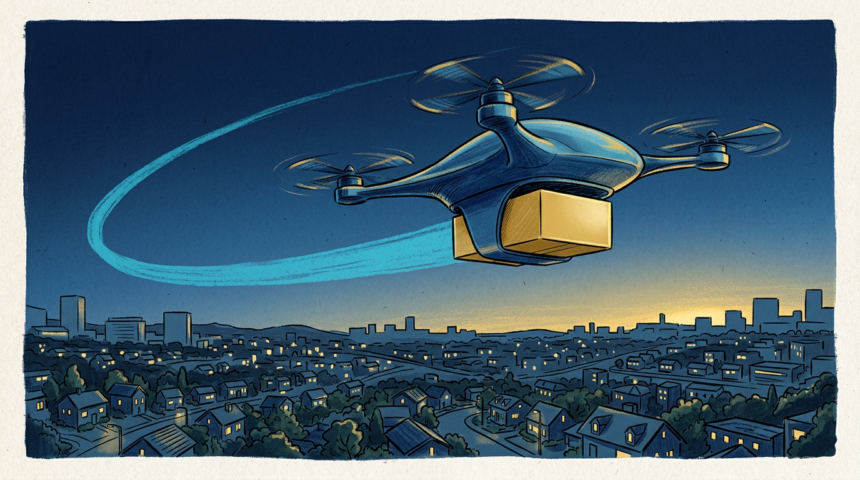
Scale is forcing Amazon’s delivery drones to think for themselves. The company plans to run Prime Air in nearly 500 US cities and towns by year end, a sixfold jump from today’s footprint that would put the service within reach of tens of millions of customers.
No airline could staff that network with human pilots watching every flight. Instead, Amazon describes the fleet’s software as highly autonomous, built to stay safe and predictable when the unexpected happens at altitude.
The drone’s own lookout does the traffic work. A detect-and-avoid system continuously sweeps the surrounding airspace, letting each aircraft find obstacles on its own and steer in real time without a remote operator.
Onboard optics manage navigation, obstacle spotting, and the final drop. Amazon’s privacy framing is blunt: the cameras are not watching people, recordings are not kept, and imagery flows only into the drone’s own navigation logic. No human monitor sees a live feed from any aircraft, per the company.
The FAA’s Part 135 certificate, the same tier commercial air carriers hold, lets the fleet add metros without case-by-case waivers. Amazon also claims its safety systems can land a drone safely in severe weather, and that drop-off noise lasts about 30 seconds, quieter than an idling delivery truck at the curb.