

Monday, 17 Aug 2026
Subscribe to AIWatcher
AIWatcher
  • Home
  • News

    Needle 2 squeezes tool calling into a 14MB model binary

    By
    AIWadmin

    Dyna-2 robot model learns from 170 years of human video

    By
    AIWadmin

    Kog bets software unlocks 30x faster inference on stock GPUs

    By
    AIWadmin

    Trust deficit, not dire warnings, drives AI backlash, Amodei says

    By
    AIWadmin

    Gas price tripling forecast clouds hyperscaler power plans

    By
    AIWadmin

    DeepSeek hikes V4 prices as Flash flubs complex agent jobs

    By
    AIWadmin
  • Articles

    New $300M fund backs AI for hospitality and venues

    By
    AIWadmin

    Ransomware operators put Claude Code inside live hacks

    By
    AIWadmin

    Claude Code bills for blank thinking blocks users never see

    By
    AIWadmin

    Liquid AI’s 3B vision model brings screen agents to laptops

    By
    AIWadmin

    Okta trims agent token bills by hiding unneeded MCP tools

    By
    AIWadmin

    Samsung trains wearable health models that learn from biosignals

    By
    AIWadmin
  • Spotlight

    Suno Studio 2.0 lets keyboards feed AI tracks with real playing

    By
    AIWadmin

    Google lets creators drop visible watermarks from Gemini output

    By
    AIWadmin

    Anthropic keeps Model 2 in the vault as misalignment risk ticks up

    By
    AIWadmin

    OpenAI crosses $40B run rate as enterprise outgrows consumer sales

    By
    AIWadmin

    Databricks tops $7B run rate as $5B round values it at $190B

    By
    AIWadmin

    SpaceX closes $60B Cursor deal to pair code agents with GPU fleet

    By
    AIWadmin
  • About
    • Mission
    • Services
    • Contact
  • Newsletter
  • Shop
    • All Items
    • By Category
      • Hats
      • T-Shirts
    • Cart
  • 🔥
  • Alignment
  • Classification
  • Distillation
  • Explainability
  • Hallucination
  • Legal/Compliance
  • Medical
  • NLM
  • Mobility
  • Research
  • Robotics
  • Safety
  • Startups
  • Prompt
  • Python
  • RAG
  • RLHF
  • Token
  • Vision
Font ResizerAa
AIWatcherAIWatcher
  • Home
  • News
  • Articles
  • Spotlight
  • About
  • Newsletter
  • Shop
Search
  • Home
  • News
  • Articles
  • Spotlight
  • About
    • Mission
    • Services
    • Contact
  • Newsletter
  • Shop
    • All Items
    • By Category
    • Cart
Have an existing account? Sign In
Follow US
© 2022 Foxiz News Network. Ruby Design Company. All Rights Reserved.
News

Stanford’s agent swarm designs a cancer drug Merck also found

Stanford's 37,000-agent virtual biotech designed a lung cancer drug that Merck independently developed and validated.

AIWadmin
Last updated: August 9, 2026 10:48 pm
AIWadmin
ByAIWadmin
Global AI news & information.
Follow:
Share
SHARE

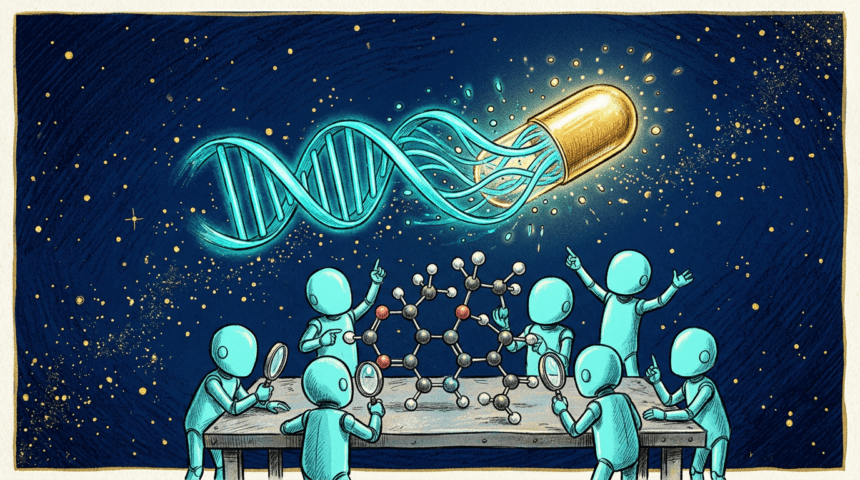
Stanford researcher James Zou described a system at the VB Transform 2026 conference that treats drug discovery like a company: tens of thousands of specialized AI agents organized into divisions that hunt for drug targets, design molecules, and run safety checks, all overseen by a chief scientific officer agent.

The so-called Virtual Biotech began as a five-to-eight-agent replica of Zou’s own lab, where AI researchers attend group meetings and even enroll in an agent school for supervised fine-tuning. Scaled up, the system spun up 37,000 clinical trial agents to synthesize fragmented trial data, and the single-cell features they identified marked drug targets about 50 percent more likely to reach market.

The most striking validation came from outside the lab. The agents autonomously designed an antibody-drug conjugate targeting the CD276 protein for lung cancer, relying only on data published before January 2025. Months later, Merck independently developed and validated the same design, which has since received breakthrough designation from the FDA. Zou called it third-party external validation of the agents’ work.

Zou argued that debates and disagreements between AI scientists produce more robust reasoning than a single model working alone, and that orchestration, not model size, is the real bottleneck. His team built Paperclip, an open platform that maps messy databases into an AI-native virtual file system, cutting time and cost by an order of magnitude compared with agents without it.


TAGGED:AI Agentsbiotechdrug discoveryMerckmulti-agent systemsResearchStanford
SOURCES:VentureBeat
Share This Article
Email Copy Link Print
ByAIWadmin
Follow:
Global AI news & information.
Previous Article Tencent opens Team Memory hub with no fix for wrong facts
Next Article Microsoft open-sources Orchard to train agents in real harnesses

You Might Also Like

News

ChatGPT logs Mac activity to build a searchable work timeline

By
AIWadmin
News

Snowflake unveils agent gateway with cost caps for enterprise AI

By
AIWadmin
News

Jensen Huang’s debut X post rallies Nvidia and Microsoft for open AI models

By
AIWadmin
News

Apple Intelligence approved for China launch with Alibaba’s Qwen AI

By
AIWadmin
AIWatcher
Facebook Twitter Youtube Linkedin Rss

Global AI News and Information
AIWatcher is your definitive source for AI updates worldwide, from Silicon Valley to Shanghai.
Our industry coverage keeps you in the loop with the latest news and trends shaping the future of AI.

Quick Links
  • News
  • Articles
  • Spotlight
  • Events
About Us
  • Mission
  • Services
  • Contact
  • Privacy Policy
  • Legal
© 2026 AIWatcher. All Rights Reserved.