


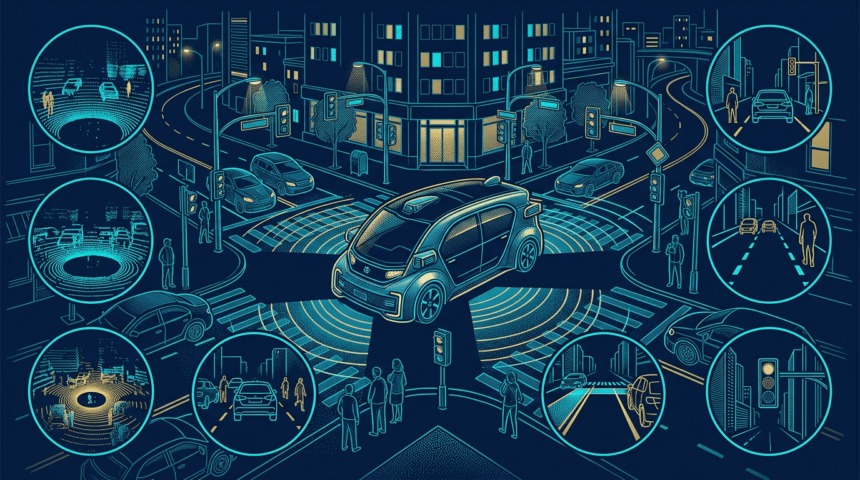
Autonomous vehicle developers now have a free path to frontier-scale driving reasoning. NVIDIA has released Alpamayo 2 Super, an open-weights model built for the rare, complex scenarios that trip up robotaxis — the long-tail events standard object detection was never designed to handle.
The model, posted to Hugging Face under the Linux Foundation’s permissive OpenMDW-1.1 license, allows automakers and suppliers to fine-tune and commercially deploy it without additional permissions. That licensing shift applies retroactively across the whole Alpamayo family, giving AV teams a direct route from adaptation to production fleets.
Alpamayo 2 Super reasons across full-surround camera views and outputs five coupled signals per situation: a planned trajectory, a chain-of-causation trace, a meta-action, auto-generated reasoning labels, and visual question answering with 2D grounding. The explainability layer plugs into NVIDIA Halos safety validation and aligns with ISO/PAS 8800 requirements, letting engineers inspect why the model chose an action.
On the LingoQA driving benchmark, NVIDIA says the model outpaced Qwen2.5-VL 72B by 17 points, Gemini 2.5 Pro by 15.1 points, and GPT-4o by 23.2 points. It also doubles as an autolabeler, compressing annotation cycles from months to days on proprietary fleet data.