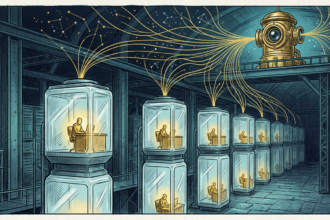
42AI, a three-year-old Israeli company, has come out of stealth with $62.5M in seed funds. Its product is a behavioural world model that assigns probabilities to what a specific person will do next.
Chief executive Amit Gal-Or and chief technology officer Ehud Ezra argue that behaviour is probabilistic rather than fixed. The model tries to infer underlying motivations instead of extrapolating from past actions, drawing on how someone behaves in situations that look unrelated to the decision being predicted.
What the model actually reads
For a brokerage client, that means onboarding steps, identity checks, support calls, the sentiment and voice in those calls, then trade timing against market conditions. Those observations become traits the transformer models forward into scenarios.
Training began with assessments of thousands of people, then moved to government and biobank sources covering more than 2 million. The founders put the reach of client data at close to 30 million individuals.
The accuracy claim and its edges
The company cites 98 percent accuracy on market trades, which Gal-Or described as the share of trading flows landing inside a predicted range rather than individual calls. Direction and volume predictions sit at an F1 of 0.8 to 0.85.
42AI says it does not need personally identifiable data and builds profiles only from linked activity. Whether that distinction holds up under financial privacy rules is a question the deployments will settle, not the pitch.
Ezra called the risk of a brokerage using such foresight against its own customers a valid concern, citing regulation and an internal ethics committee. Expansion into gaming and fraud detection is under way, and robots that understand people are the long-term ambition.