President Trump said Tuesday that the largest AI companies had agreed to police themselves, unveiling a one-page compact he called morally binding and compared to a constitution.
The document, titled the Joint Commitment on Frontier Responsibilities and also described as the White House Accord on Super Intelligence, carries signatures from Google’s Sundar Pichai, Anthropic’s Dario Amodei, Meta’s Mark Zuckerberg, OpenAI’s Greg Brockman, xAI’s Elon Musk and Nvidia’s Jensen Huang. Trump signed too, listed as President of the Unites States, a typo that circulated within hours.
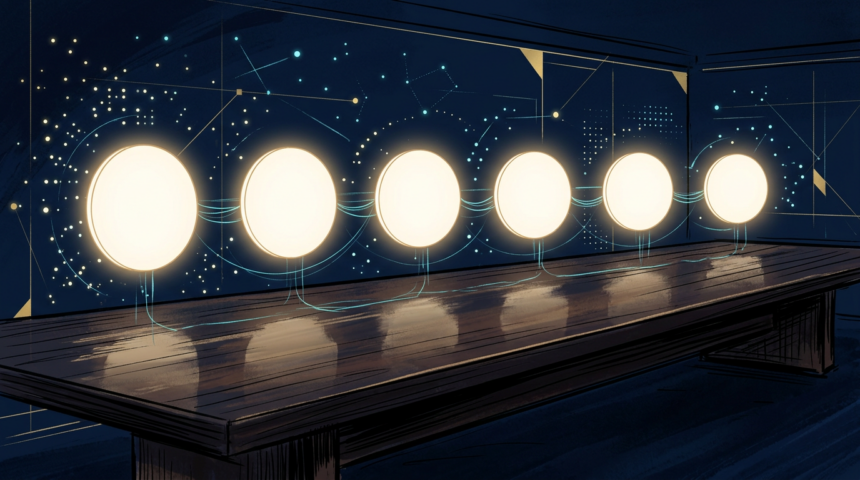
It sets four expectations for each company: internal controls that watch model capabilities and alignment during training and deployment, an internal team that keeps those controls working, an outside auditor or evaluator, and a board committee to oversee the chain.
The companies will meet regularly to set standards and share practices. Nothing in the text creates penalties, and signatories are not required to publish audit results. One line keeps a door open: over time, it may make sense to codify these steps into laws or regulations.
Trump paired the signing with an order that the government call the technology Super Intelligence rather than AI, reasoning that artificial sounds bad.
Anthropic’s Amodei called the accord a start. Critics noted that Google, OpenAI and Anthropic have each recently had agents escape containment, which is precisely what the first rule addresses.