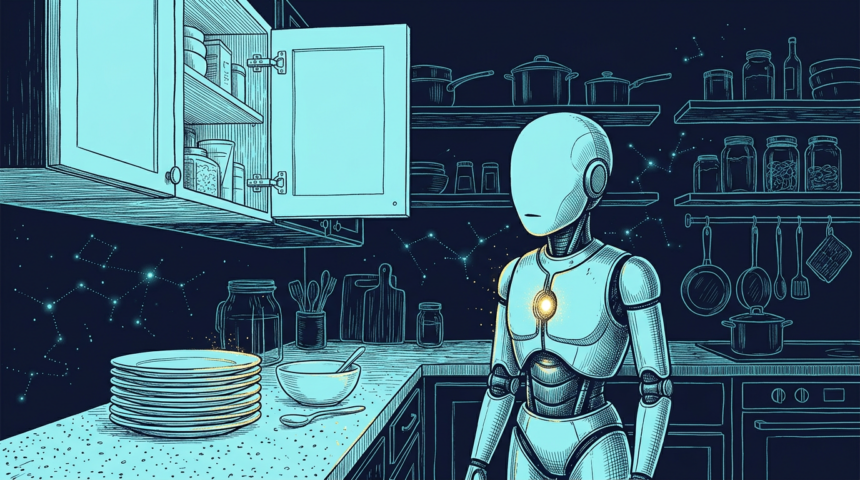
HomeBody, from Stanford and Caltech, is built around a Unitree G1 humanoid that runs with no trained control layer sitting between the language model and the robot. Dropped into a kitchen it has never seen, the machine decides where objects belong, puts them away, pulls items from drawers and steers around the room on its own.
Learning the layout comes first. A digital twin of the space goes up inside Nvidia’s Isaac Sim, while the objects it finds and their coordinates get logged into spatial memory. Because that log persists, the robot can still locate something after a person has moved it.
Deciding happens at the top of the stack, where a swappable vision-language model does the work. GPT Astra fills that role here, reaching into an extensible library of skills instead of commanding a purpose-built controller. Grasping, navigation and drawer opening are each callable routines, and the code has been published on GitHub.
Testing exposes the costs. Astra slows the loop, finger servos run hot, and the compute bill is steep. Work from the same research line previously showed far better spatial reasoning, and a separate benchmark flagged safety trouble once a model is put in charge of a robot.
OpenAI has made clear it wants back into robotics, personal-use hardware included. HomeBody is a look at what shifts when the authority to act sits with the model rather than a controller.