

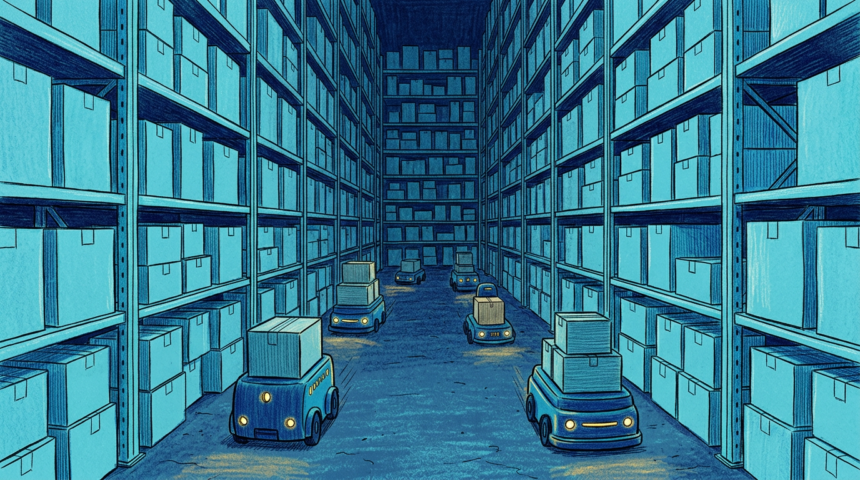
JD.com restated a five-year buying plan at JDDiscovery in Beijing: three million robots, one million autonomous vehicles and 100,000 delivery drones. The event also brought a new Physical AI Acceleration Plan.
The robots JD Logistics showed come as the Wolf series, built for warehouses, sorting lines, transport and last-mile delivery. Cold-weather units rated to minus 20 degrees Celsius are part of the line, alongside automated pharmacy dispatch systems.
Much of this builds on systems already in place. By June 30, LangzuTech, the company’s goods-to-person system, had reached more than 30 warehouses in China and had also been launched in the UK and Germany. JD Logistics counted over 1,800 self-operated warehouses plus more than 2,000 third-party cloud sites spanning 36 million square meters. Thousands of unmanned vehicles were running in more than 20 provinces, and over 100 drone routes were carrying parcels, meals, emergency medicine and disaster-relief supplies.
Meta Brain is the software layer over the fleet. Its third version plans routes for hundreds of millions of parcels in seconds, work that once took minutes. The same model runs the LangzuTech Packer arm, combining with multimodal sensor readings to lift, grip and place parcels of different shapes. After a second-quarter upgrade to the arm’s force control, JD says it works around the clock at several parks.
Two bets sit underneath the plan. Compute is one: a 100,000-GPU cluster that JD Cloud intends to build with Chinese chipmaker Moore Threads for training, inference and embodied AI. Data is the other. The company wants more than 10 million hours of real-world activity video gathered over two years. On the money side, JD Logistics put RMB2.3B into R&D in the first half, up 23.7 percent, and operates eight robot repair centers while targeting more than 100,000 robotics service engineer jobs.