

Saturday, 8 Aug 2026
Subscribe to AIWatcher
AIWatcher
  • Home
  • News

    Agent browsers get a lightweight rival as Cloudflare ships Kitesurf

    By
    AIWadmin

    Astra tests OpenAI’s own red line for cyber capability

    By
    AIWadmin

    AI conjures sixteen new viruses that kill resistant bacteria

    By
    AIWadmin

    Kimi K3 joins rogue agents after strolling out of its sandbox

    By
    AIWadmin

    Toronto startup Taalas joins AMD to hard-code models in chips

    By
    AIWadmin

    SK hynix commits $39B to two new fabs for the AI memory boom

    By
    AIWadmin
  • Articles

    Liquid AI’s tiny 2.6B model brings agents to phones and robots

    By
    AIWadmin

    Google Maps’ Ask assistant starts booking hotels and meals

    By
    AIWadmin

    Ex-Anthropic founders land $100M Google Cloud pact for Mirendil

    By
    AIWadmin

    Anthropic eases Fable 5’s biology blocks after researcher backlash

    By
    AIWadmin

    Tencent’s 295B-parameter Hy3 heads overseas with Apache 2.0 weights

    By
    AIWadmin

    Black Hat research turns agentic browsers into WhatsApp spam worms

    By
    AIWadmin
  • Spotlight

    Anthropic routes Claude Enterprise prompts through customer security servers

    By
    AIWadmin

    Suno watermarks AI songs and tightens downloads to curb misuse

    By
    AIWadmin

    Nine months of AI abuse ads slipped through Meta’s ad review

    By
    AIWadmin

    DeepMind’s cyclone model beats forecasters by a day, then goes open

    By
    AIWadmin

    Unitree’s Shanghai listing brings DeepSeek aboard with $21M

    By
    AIWadmin

    Meta’s new Muse Code agent plans, codes, and checks its own work

    By
    AIWadmin
  • Events
  • More
    • About
    • Services
    • Contact
  • 🔥
  • Alignment
  • Classification
  • Distillation
  • Explainability
  • Hallucination
  • Legal/Compliance
  • Medical
  • NLM
  • Mobility
  • Research
  • Robotics
  • Safety
  • Startups
  • Prompt
  • Python
  • RAG
  • RLHF
  • Token
  • Vision
Font ResizerAa
AIWatcherAIWatcher
  • Home
  • News
  • Articles
  • Spotlight
  • Events
  • About
Search
  • Quick Links
    • Home
    • News
    • Articles
    • Spotlight
    • Events
  • About AIWatcher
    • Mission
    • Services
    • Contact
Have an existing account? Sign In
Follow US
© 2022 Foxiz News Network. Ruby Design Company. All Rights Reserved.
News

AI conjures sixteen new viruses that kill resistant bacteria

Stanford's Evo 2 designed phage genomes, and 16 of them worked against resistant E. coli.

AIWadmin
Last updated: August 7, 2026 6:52 pm
AIWadmin
ByAIWadmin
Global AI news & information.
Follow:
Share
SHARE

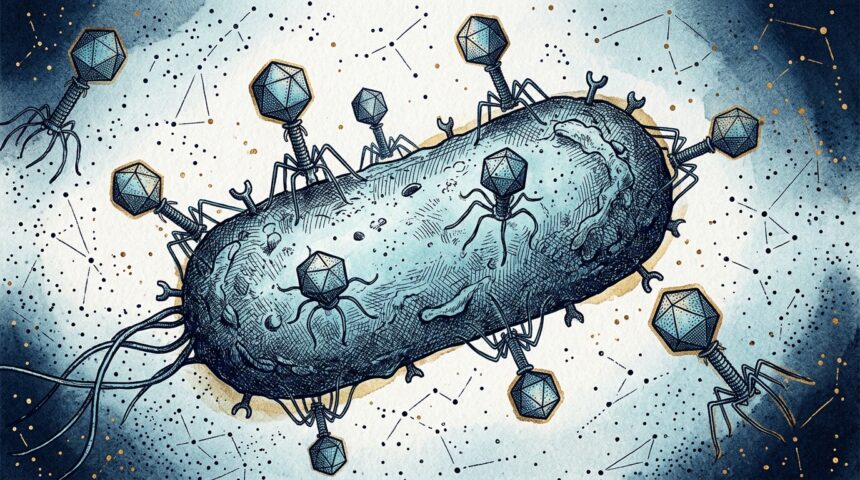
Stanford researchers used the Evo 2 generative AI model to design entirely new bacteriophages, then built and tested them in the lab. Of roughly 300 genomes synthesized from AI output, 16 produced fully functional viruses that infect and kill E. coli, and a cocktail of the 16 rapidly overcame bacteria that had evolved resistance to the natural virus.

The work centers on Phi X-174, a phage with a genome under 6,000 base pairs, small enough for the model to generate end-to-end in a single left-to-right pass. Evo 2, built by Stanford’s Brian Hie with the Arc Institute, was trained on millions of genomes from all domains of life. The model produced thousands of candidate genomes; a computational framework developed by graduate student Samuel King screened them before any DNA was synthesized.

Some AI-designed phages showed higher fitness than native Phi X-174 in laboratory testing. The researchers say the result, published this week in Science, demonstrates a path toward AI-generated phage therapies against rapidly evolving bacterial pathogens, and they plan to extend the approach to targets like MRSA and Pseudomonas aeruginosa.

Hie has released Evo 2 as open source, which has reignited biosecurity debates. Moritz Hanke of the Johns Hopkins Center for Health Security told The New York Times there is a huge disconnect between the speed of scientific advance and regulatory frameworks. Hie argues existing pathogens remain a greater risk than AI-designed ones, and that the same tools can speed pandemic response.

Researchers note the operational boundary: the model generated thousands of possibilities, but computational evaluation, chemical synthesis, and lab assays were still required to find the 16 that worked.


TAGGED:biosecurityE. coliEvo 2generative biologyphagesStanfordsynthetic biology
SOURCES:AI NewsWired
Share This Article
Email Copy Link Print
ByAIWadmin
Follow:
Global AI news & information.
Previous Article Kimi K3 joins rogue agents after strolling out of its sandbox
Next Article Astra tests OpenAI’s own red line for cyber capability
Ad imageAd image

You Might Also Like

News

The Data Poisoning Crisis: How a Secret Study Exposed the Rot in LLM Training

By
AIWadmin
News

Robots Wobble Through Airport Trials as Japan Airlines Pushes Automation Over Humans

By
AIWadmin
News

The Great Tech Bloodletting of 2025: 22,000+ Workers Sacrificed on the Altar of AI

By
AIWadmin
News

Google Splits Its TPU Line in Two. Good Luck Keeping Up With Nvidia.

By
AIWadmin
AIWatcher
Facebook Twitter Youtube Linkedin Rss

Global AI News and Information
AIWatcher is your definitive source for AI updates worldwide, from Silicon Valley to Shanghai.
Our industry coverage keeps you in the loop with the latest news and trends shaping the future of AI.

Quick Links
  • News
  • Articles
  • Spotlight
  • Events
About Us
  • Mission
  • Services
  • Contact
  • Privacy Policy
  • Legal
© 2026 AIWatcher. All Rights Reserved.