



As first reported by Crunchbase, Nabla has raised $70 million in Series C financing to scale its AI-powered clinical assistant platform, bringing its total funding to $120 million since its launch in 2018.
The round was led by Germany’s HV Capital, with participation from Highland Europe, DST Global, Cathay Innovation, and Tony Fadell’s Build Collective. Though the company did not disclose its current valuation, it was last valued at approximately $180 million following its Series B earlier this year.
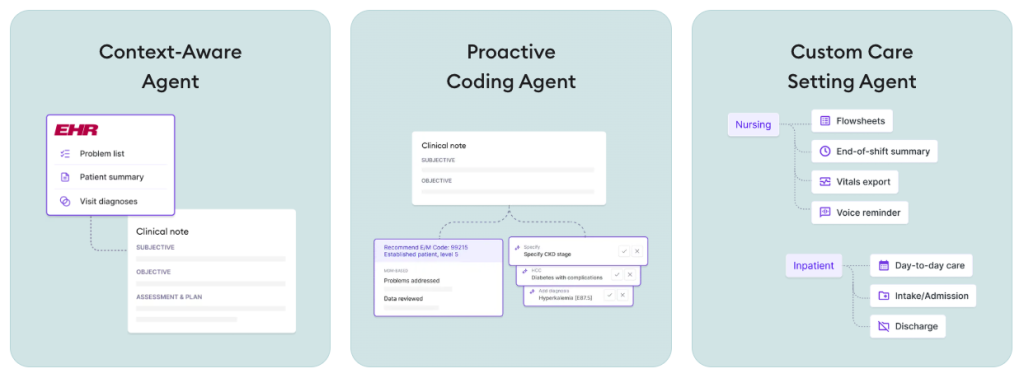
Source: nabla.com.
Nabla’s technology, already embedded in over 130 healthcare organizations, acts as a digital copilot that generates clinical notes and documentation for over 85,000 clinicians. The AI assistant is credited with reducing documentation time by over 50%, lessening clinician burnout, and improving patient satisfaction. Over the past six months, Nabla reports that it has increased its revenue fivefold, though it hasn’t shared exact revenue figures.
With the new funding, Nabla plans to evolve its system into what it calls an “Adaptive Agentic Platform.” This next phase will expand the toolset from documentation toward real-time, decision-support functions—such as a billing code assistant that detects reimbursement issues and a context-aware agent that draws from historical data and integrates directly with electronic health records (EHRs). New features will also cater specifically to nurses and inpatient teams.
This move comes amid a global surge in AI investment. According to Crunchbase, AI startups accounted for nearly half of all U.S. venture capital in the past year, with later-stage deals comprising 61% of that activity. Globally, AI dominated Q1 2025 funding, capturing an unprecedented 53% of all VC dollars and setting a new quarterly high at $59.6 billion.
Nabla’s significant funding and strategic pivot to broader AI agency in healthcare highlights the accelerating integration of artificial intelligence into clinical settings. As investor confidence in healthcare-focused AI continues to grow, startups like Nabla are poised to redefine how care is delivered, documented, and optimized—ushering in a new era of intelligent, adaptive medical support.