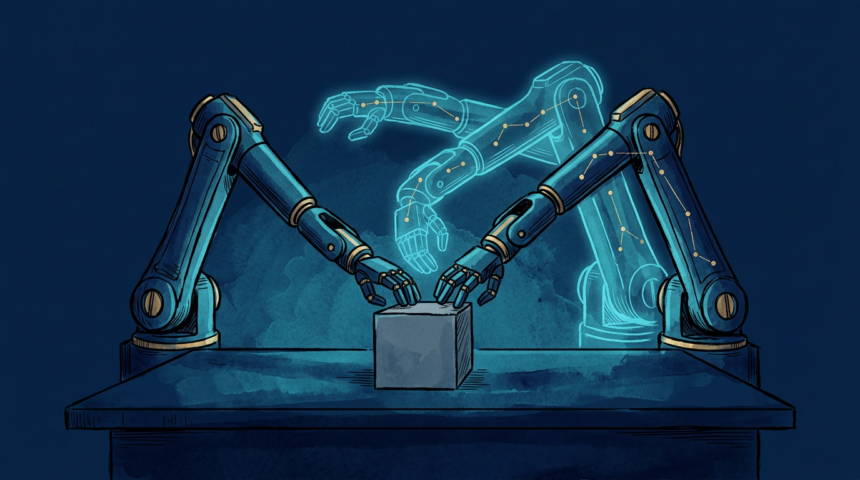
Robot policies usually act on whatever the camera shows at that instant. Kyutai, working with Inria and Ecole des Ponts, has released a vision-language-action model that carries a short memory without paying much for it.
REKI pairs a Qwen3.5-2B vision-language backbone with a 200M-parameter action expert, for 2.4B parameters total. Action chunks are generated by flow matching in 10 Euler steps, with robot state and flow time injected through adaptive RMSNorm.
Memory sits in the action expert rather than the language model. Ahead of each frame’s action tokens are 32 learned register tokens that cross-attend the encoded prompt and camera views, then self-attend the registers of earlier frames. They never read action tokens, so they can be computed once per frame and cached.
The accounting is modest. Reading cached registers adds 0.1 ms to a 21.8 ms chunk on a single H100. Each past frame costs about 2 MiB of GPU memory across a rolling three-frame window.
The payoff shows up as a specific failure. Without memory, arms often oscillate between two poses, which Kyutai attributes to perceptual aliasing. On RoboTwin those episodes fall from 18.6 percent to 4.1 percent.
Pretraining on public data only, it leads models of its size class. REKI scores 90.4 percent on LIBERO-Plus, ahead of Qwen-RobotManip at 89.0 and pi-0.5 at 85.7, and 65.8 on RoboTwin Clean2Rand behind Qwen at 68.5. On RoboCasa365 it returns 38.4 percent, well short of Xiaomi-Robotics-1 at 57.4.
Weights are on Hugging Face in BF16, with no quantized variants announced yet.