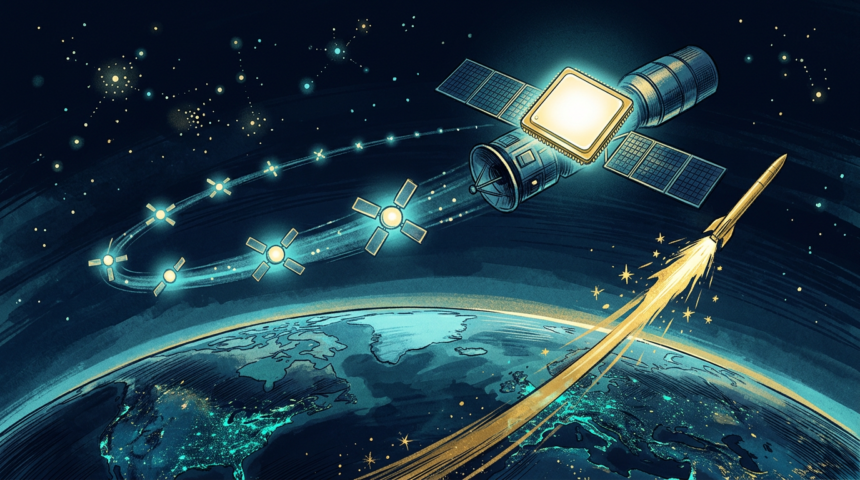
A Google Tensor Processing Unit is circling Earth for the first time. The chip rode a SpaceX rocket from California this week inside a satellite built by Planet Labs, and its job is to prove a TPU can run away from the ground.
That means holding a kilowatt of continuous power, shedding heat, and crunching models without failing. Google will run it in 15-minute bursts so the satellite’s power and thermal budgets hold.
The craft belongs to Project Suncatcher, the company’s bet on orbital compute clusters. “There’s no test that’s completely as good as the real thing,” said Travis Beals, the executive running it. A second flight next year should pair two purpose-built satellites over a laser link, and the eventual target is 81 satellites processing in formation.
Cost is the open question, so Google published a peer-reviewed paper in Joule. It reasons that SpaceX has shaved launch prices about 20 percent a year since Falcon 1, putting $200 per kilogram within reach by 2035. Google is a SpaceX investor and, like the rest of the data center industry, needs Musk’s rockets to make the math work.