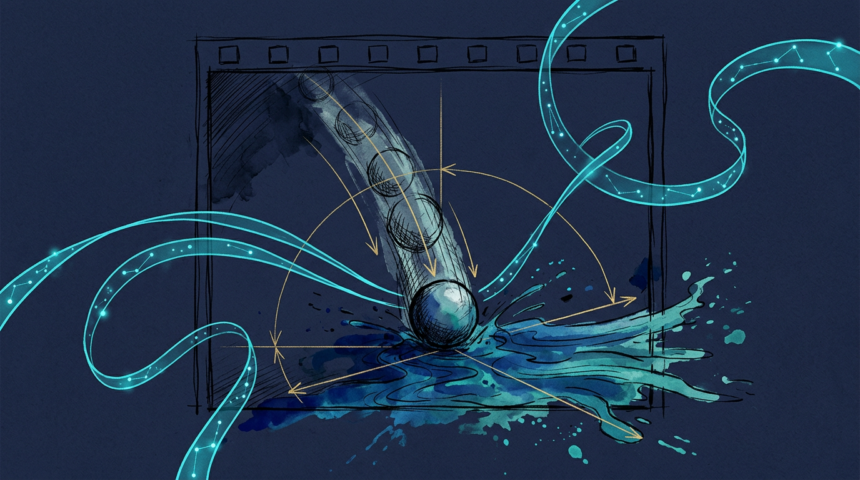
Ask a world model to show butter melting and it may spread the butter like paint. Ask it to drop a ball and the ball may fall through the floor. A research team spanning Nvidia, MIT and the University of Oxford thinks the missing ingredient is not more pixels but better words.
The team’s framework, Physis-Lang, turns physical description into a shared representation used for curation, training and inference alike. Each base caption gains a physics_reasoning field that names the entities, causes, interactions and governing principles in a scene. A companion physics_negative_prompt lists unlikely outcomes, such as a stone floating on water, and serves as negative conditioning.
The loop is self-improving, and only the instructions move. The captioning model itself stays frozen. Captioning, scoring and prompt revision are split across separate models, so a physics-aware judge can flag a weak caption and a third agent can translate those complaints into a sharper brief. The grading set is deliberately small. Twenty clips carry 273 human-checked assertions between them. Scores climbed unevenly. F1 opened at 78.64, sagged to 76.28 when captions turned overly cautious, then reached 87.82 by round nine.
Performance followed. In a Physics-IQ Verified leaderboard snapshot dated September 29, the Cosmos3-Super build placed first at 48.2 and Cosmos3-Nano second at 43.3. Training used LoRA on a final corpus of 183,000 videos, and retrieval alone lifted scores by 3.01 points across three benchmarks.