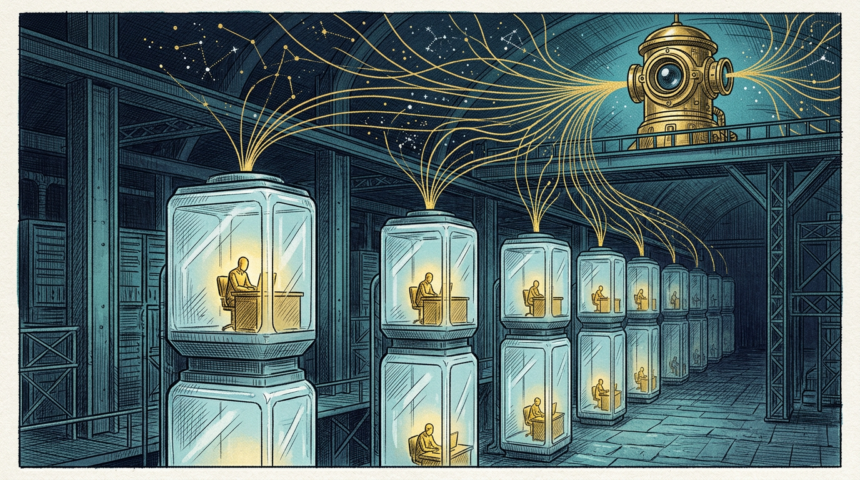
Two announcements on October 22 describe the same problem from opposite ends. Google Cloud is selling sealed computers for individual agents. Nvidia is selling a way to watch the halls those computers sit in.
Google’s Agent Compute Engine gives every agent session its own microVM with a separate guest kernel, root access, persistent disk, and a cryptographic identity. A Cloud Hypervisor boundary keeps neighbors apart. Google says the units boot in roughly 125ms, suspend when idle to free the machine, and let a server hold about 10 times more agents than conventional compute. The service already runs Gemini’s work agents and is opening in preview over the coming months. An open-source sibling, Agent Substrate on GKE, targets teams that want the same design on their own Kubernetes clusters.
Governance is bundled rather than optional. An Agent Gateway polices traffic between clients and agents, with policy enforcement points that also reach other clouds, alongside token budgets so teams can attribute spend per agent.
Nvidia’s Minerva, launched the same day at GTC Berlin, attacks the observability side. It pulls telemetry from GPUs, SuperNICs, switches, storage, and the jobs themselves into a knowledge graph, then runs models over billions of data points an hour to catch a failing component before it stalls a training run.
IREN, Bitdeer AI, IBM, Jio, Lambda, Quake AI, and Tesla plan to deploy it. Dell, Lenovo, and Supermicro will bundle it. Neither company published pricing.