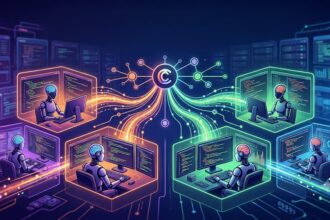



DeepSeek is moving beyond the model layer with Harness, an open-source agent framework that gives developers a modular alternative to Claude Code and OpenAI’s Codex. The tool, called dsh, launched August 13 under the MIT license with a design principle of everything is a plugin.
Models, tools, skills, sessions, sandboxes, and interfaces are all replaceable components, so builders can mix DeepSeek, Anthropic, or OpenAI models into one workflow. The developer preview runs from npm with a single command and already handles repository inspection, file edits, shell access, search, planning, subagents, and approval policies.
The repo drew roughly 27,500 GitHub stars on launch day, a sign of hunger for open agent infrastructure.
Harness arrived alongside the official release of DeepSeek-V4-Pro-0813, which upgrades the flagship with enhanced agent capabilities, native support for OpenAI’s Responses API, and one-click setup for Codex. The model keeps its one-million-token context window and adds explicit reasoning controls, letting developers choose Non-think, Think High, or Think Max per task.
DeepSeek reports strong agent benchmarks for the 0813 build, including 87.9 on Terminal Bench 2.1 and 74.1 on Toolathlon-Verified, though the figures are company-reported.
The combination is strategic: DeepSeek already undercuts rivals on token prices, and now it offers the harness layer for free, putting pressure on integrated products that lock developers into one vendor’s stack.