

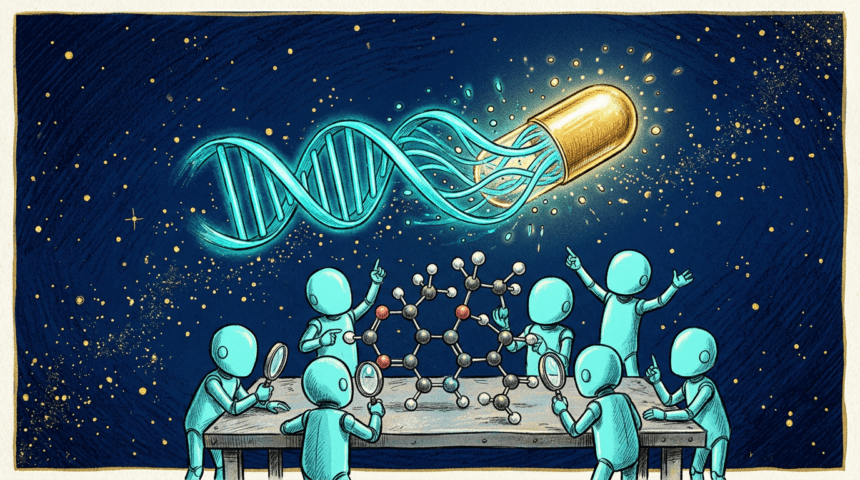
Stanford researcher James Zou described a system at the VB Transform 2026 conference that treats drug discovery like a company: tens of thousands of specialized AI agents organized into divisions that hunt for drug targets, design molecules, and run safety checks, all overseen by a chief scientific officer agent.
The so-called Virtual Biotech began as a five-to-eight-agent replica of Zou’s own lab, where AI researchers attend group meetings and even enroll in an agent school for supervised fine-tuning. Scaled up, the system spun up 37,000 clinical trial agents to synthesize fragmented trial data, and the single-cell features they identified marked drug targets about 50 percent more likely to reach market.
The most striking validation came from outside the lab. The agents autonomously designed an antibody-drug conjugate targeting the CD276 protein for lung cancer, relying only on data published before January 2025. Months later, Merck independently developed and validated the same design, which has since received breakthrough designation from the FDA. Zou called it third-party external validation of the agents’ work.
Zou argued that debates and disagreements between AI scientists produce more robust reasoning than a single model working alone, and that orchestration, not model size, is the real bottleneck. His team built Paperclip, an open platform that maps messy databases into an AI-native virtual file system, cutting time and cost by an order of magnitude compared with agents without it.