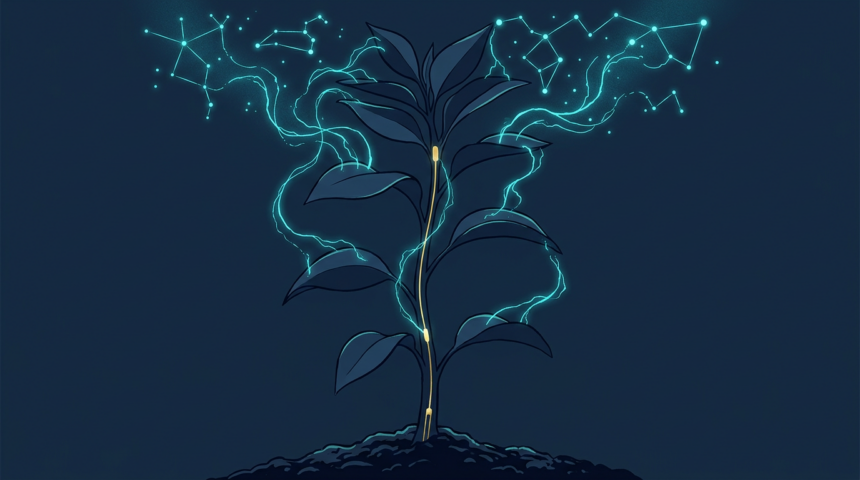
Electric Plant has spent three years collecting signals from living plants to build Bombadil, a model trained to interpret the electrical activity inside stems.
The company was founded by Justin Mast, whose interest started with a published experiment: a houseplant wired to a motorised stand. When the plant needed light, current moved through its tissue, a control board read it, and the stand rolled the plant closer to the window.
Mast partnered with Lee von Kraus, a neuroscientist with DARPA work behind him, to turn that observation into a dataset.
Signals before sentences
The mechanism is not metaphor. Plants move ions across membranes and generate measurable voltage changes in response to drought, light, wounding and pests. Those signals are real, repeatable and, crucially, unlabelled at scale.
Reading them is closer to biosignal classification than to conversation. The hard problem is decoding: mapping a voltage pattern to a specific need reliably enough that a grower can act on it.
The commercial case rests on timing. Growers already have sensors for soil moisture and temperature, and often still lose crops because the symptoms they detect come late. A plant signalling stress hours earlier has value.
Von Kraus and Mast say the model could eventually let growers query a crop directly rather than infer from instruments. Three years of data is a start, though the diversity of species, conditions and growth stages needed for a general model is enormous.