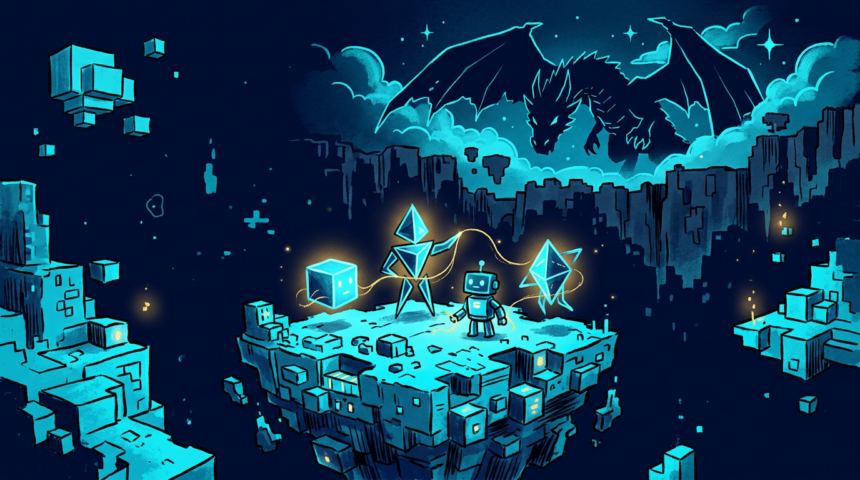
Minecraft had already been beaten by software built for the job. The difference in this run is that nobody handed the players a plan, a role assignment, or a set of game-specific tools.
Google DeepMind researchers placed four agents powered by Gemini 4 Argon into a randomly generated world and let them work it out. They divided labor on their own initiative, called out threats to each other, retrieved gear from fallen teammates, and wrote failures into a shared memory so the same mistake would not repeat.
The session ran 27 hours and 14 minutes of game time and ended with the Ender Dragon dead. Along the way the group wrote 2,783 separate JavaScript programs, exchanged 229 chat messages, and died 605 times.
Cost is the less heroic part of the record. The full run came to $1,620 at the standard Gemini 4 Argon rate scheduled for 2027. Dying 605 times is expensive when every recovery involves a model call.
The result extends a trend. Games that once needed purpose-built reinforcement learning systems, trained from scratch with hand-shaped reward functions, are now falling to general models given a keyboard and a goal. Multi-agent coordination is emerging from the harness rather than from the training objective.
Twenty-seven hours to clear the game still trails a skilled human, who can finish in well under an hour. But the interesting comparison is no longer speed. It is that the agents improvised roles, negotiated a shared plan and kept notes across a session longer than a working day, with no supervision at all.