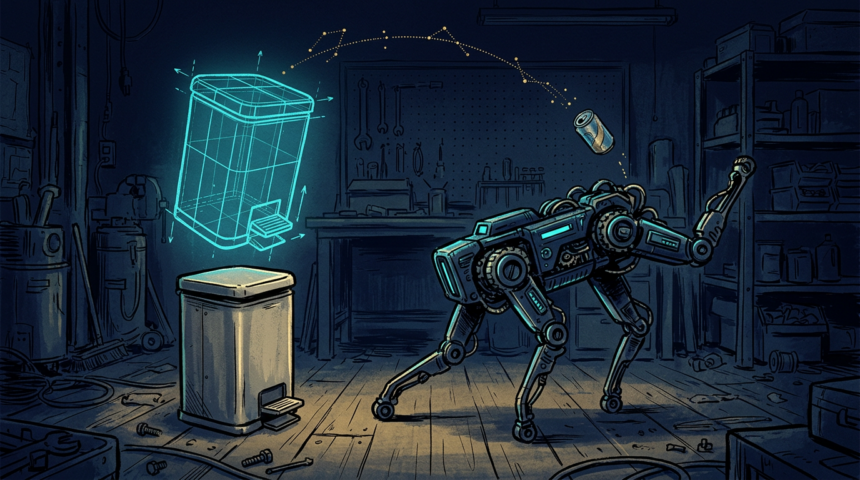
One model for the whole robotics pipeline is how Google is framing Gemini 4 Argon: it grades the results, builds practice worlds, and drives hardware. Its own demonstrations, though, reveal how much hand-holding the approach still demands.
In the showcase, the goal is for a Boston Dynamics Spot unit to knock soda cans into a bin that opens on a step. A virtual copy of that bin gets built by Argon before the machine touches the real pedal, and there the robot practices balancing on three legs. Correct positioning of the foot and gripper is then confirmed by two extra AI agents before the can is released.
One photo, thousands of attempts
Scattered party props on a table, shown in a single image, became a virtual replica from which the model produced 77 tasks – righting toppled objects, clearing the surface, and more. A control model was fed more than 4,500 training episodes. On real hardware the payoff showed: execution time fell from 35 to 24 seconds, while the success rate climbed from 56 to 75 percent.
Other inputs work too. A teleoperated robot recording is rebuilt into a simulation matching fingertip force readings, a human first-person video is mapped onto a virtual five-fingered humanoid, and even a ballpoint sketch of a robot toppling a box pyramid becomes a throwing motion.
Directing a world model
Generated video carries one demonstration end to end. Gemini Omni, the world model, produces clips of a scene changing, while Argon acts as director – writing timestamped hand instructions, inspecting frames, and revising its next command. Arranging five scattered letter tiles into a word took it 33 steps.
Google calls the work another stride toward physical AGI, yet the examples show a coordinator that still relies on a human-written script and verification agents.